


How long does SEO take? And how to speed up the results
SEO usually takes 3–12 months before traffic moves, and real commercial impact often 6–24 months. What decides it is what you do with the time.

SEO generally takes 3–12 months before you see clear results in the form of more traffic and better rankings. For a new website in a low-competition niche it can move faster, while stable top rankings in competitive sectors often take 6–24 months of deliberate work before the real commercial impact lands.
How long does SEO take? It is the perennial question, and we will try to answer it properly.
- The short answer: 3–12 months
- The long answer: it depends (how long is a piece of string?)
As well as giving a fuller answer on how long SEO takes, we will give you concrete ways to speed up the results.
In this post we answer:
- What actually decides how quickly you see results
- The difference between early traffic and real commercial impact
- Concrete ways to speed up the process
- How core updates affect the timeline
We are a search marketing agency with 14 years in search. If you are weighing up whether SEO is worth the wait, this should help you decide.
The key points in brief
- SEO usually delivers visible results after 3–12 months.
- Stable top rankings in competitive sectors typically take 6–24 months before the commercial impact lands.
- Your effort and the quality of your work count for more than how long you have been at it.
- Google core updates are often the big turning points for rankings.
- Established, authoritative domains can rank new content within hours – new websites face a real headwind at first.
What is your goal?
The timeline for SEO depends entirely on what you are aiming for. The first question is obvious, but it has to be asked: what is your goal with SEO? If the goal is to rank for a single keyword, SEO can move quickly. If the goal is to have the most organic traffic in your sector, and to be able to drop paid channels altogether to lift your profitability, it comes down entirely to the competition.
As a rule, you see an effect the day after something is indexed. SEO is a long-term process, and the timeline for results depends on several factors.
So the real question is: how long does it take for SEO to pay its way?
How long does SEO take to become profitable? Picture the return on investment plotted over time. SEO typically runs at a loss for the first months, then overtakes paid search and keeps climbing, while the return from paid clicks stays fairly flat.
The difference between early traffic and commercial impact
It is easy to confuse when the traffic arrives with when the money arrives. Early rankings for long-tail keywords can show up within 3–6 months, but that does not mean your cash flow has changed. Real commercial impact – where SEO replaces or complements paid channels profitably – more often lands somewhere in the 6–24 month range.
The question to measure is not “are we visible?” but “are we making money from the traffic?”. That is where SEO becomes interesting as a business case. You can rank for irrelevant keywords for months without a single pound coming in.
Competition matters
Competition is the single biggest factor in how long SEO takes. What sets SEO apart from other channels is that only one result can sit at the very top.
If there are important keywords you need to be visible for, the work is ongoing, even if the amount of it can drop over time.
If competition is low, you can wind the work down to almost nothing once you have won. But SEO has become so popular that nearly every sector, especially on the important keywords, has other SEO specialists competing with you. It is an ongoing process that takes patience and strategic work.
The sandbox for new websites
The Google sandbox is what SEOs call the filter new websites seem to pass through while Google screens out spam. Google has said publicly that it has no sandbox, although the internal documentation that leaked in 2024 describes a site-age signal used “to sandbox fresh spam”. Whatever the name, a new website has to earn Google’s trust before it ranks properly.
It can take weeks to months to build up enough trust for full indexing.
This is where the gap between a new domain and an established one is stark. Established domains with strong accumulated trust can rank new content within a few hours – Google already trusts them and does not need to check them again and again. A new website faces the opposite headwind: even good content can sit unseen for weeks before Google decides to trust you.
If you are new, that means you should not measure yourself against established competitors in the first few months. You are not playing the same game.
Effort matters more than time itself
Time is not a ranking factor – what you do with the time is. The days pass at the same speed for everyone, so in that sense time is an irrelevant factor. What counts is what you do. Waiting for things to improve, or putting other sites’ rankings down to them having been around longer, will not help you.
To get the most out of SEO, we recommend our guide to SEO strategy.
Bear in mind that time can also work against you. Websites that stand still can slip, because Google judges them to be less relevant than they were.
How long does it take Google to find what I have done?
Google finds new pages within anything from a few hours to several weeks, depending on how often it visits your website. Google does not work in real time. Google is a profit-making company. It only spends resources visiting you if it thinks something new may have appeared.
If you have not worked on SEO before, or have not updated the website regularly, it is not unusual for us to see indexing take 4–10 weeks or more.
At first you may need to ask Google to index the new pages you create. The easiest way to do that is through the URL Inspection tool in Google Search Console, where you can request indexing for a page.
If you do not already have an account, you can set one up in Google Search Console.
Slow indexing tends to go hand in hand with weaker rankings. Read more about crawl budget.
Once you have kept activity on the website high for a while, Google will give you more priority – provided it likes what you are doing. At that point you no longer need to request indexing for pages; it is better to let Google find them naturally.
Bear in mind that when you request indexing for a page, Google generally finds only that page. It does not pick up the internal links pointing to it, so the full effect takes longer. The end result is no better, but you can speed up the moment Google notices that something is happening on your site.
Google core updates – what do they mean for the timeline?
Google core updates are the big turning points where rankings jump. Many people know that Google’s algorithm changes daily. Those are generally very small changes that matter little to the bigger picture.
The large core updates come, in Google’s own words, “several times a year”. The Google Search Status Dashboard lists three or four a year from 2023 to 2025, and most took two to three weeks to roll out. Google also says it continually makes smaller core updates that are not announced, and that you do not necessarily have to wait for a major core update to see the effect of your improvements. So simply waiting for the next big update is not a plan. Check the dashboard to see what is rolling out right now.
We love core updates. Why?
We are driven by results. But you rarely get the full effect of your work straight away.
Results jump much more around a core update. If you have done everything right, you can come out of one as a big winner.
Below is an example from one of our clients, whose results took off after an update (the Google logos mark the different updates; the one around 21 August is a core update).
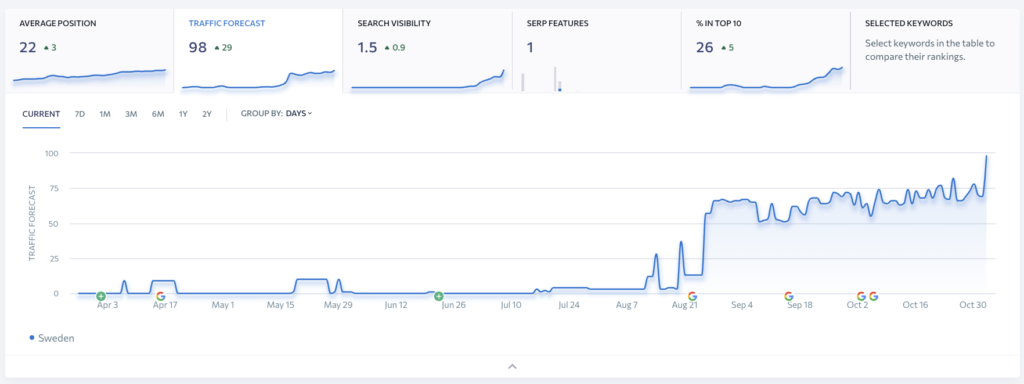
Make sure that, before the next update, you give Google reason to change its view of you. The aim is to become the expert in your sector, with a genuinely good website that users love.
If you want help getting there, see how we work as an SEO agency.
What can I do to speed up SEO results?
- Work at a faster pace than your competitors, and to a higher standard
- Update old content
- Understand how Google is changing (so future updates favour you more than the others)
- Do not target individual keywords too quickly or too obviously
- Work on several different ranking factors – on your website and off it, for example
- Do the safe bets first, and quickly – load time, technical errors and better UX, for example
Common misconceptions and expectations
There are several common misconceptions about SEO that can give website owners unrealistic expectations:
- That SEO results are immediate: SEO is a long-term process that takes patience and deliberate work.
- That SEO is simple: SEO is a complex process that requires a deep understanding of search engine algorithms and user behaviour.
- That SEO is a one-off job: SEO is an ongoing process that needs continuous optimisation and adjustment to hold and improve the website’s rankings.
How long does it take to recover if Google has penalised me?
If Google has penalised you (you lose rankings quickly without having changed anything yourself), there are two things you can do:
- Hope it sorts itself out
- Start playing by the rules
Unfortunately I cannot give a short answer on what to do if you have been penalised. But it usually comes down to aggressive external links with exact-match anchor text, or over-optimised on-page SEO.
- Improve the user experience
- Fix your technical SEO
- Update old content
- Delete thin pages and those that contribute nothing
- Create quality content that gives the user real value
Once you have done this for long enough, and Google has seen all the good work, you often have to wait for Google’s next core update before things start to move.
Something I have found works well is making one genuinely large change. That could be an entirely new website, or several changes at once. It forces Google to reassess you.
What happens if I stop doing SEO?
At first: nothing.
Over time: your keyword rankings will fall. Others will catch up and build a lead over you.
How quickly does that happen? It depends on the competition, how big a lead you have, and how much it matters in your sector that content is kept up to date.
It is easier to ride the wave than to keep starting again.
Does the age of the domain matter?
Judging by the Google documents that leaked in May 2024, Google does appear to record domain age. How much it matters is not clear.
As a rule, what counts is how long you have been indexed for something, and the trust you have built up.
So URLs that have been indexed for a long time with old content do not necessarily rank better than a new website with new content.
As with everything else, bear in mind that it depends.
A blog post about SEO from 2018 is no longer of interest; for topics like that, updated content matters more. Other, more static subjects do not need updating, and then an older page can be the better option.
Is time a ranking factor?
Time in itself is not a strong ranking factor. How long SEO takes has to do with effort and history.
Over time, though, you tend to build up more trust. Even so, URLs indexed over a long period with old content do not necessarily rank better than a new website with fresh content.
History can make it go faster
Established, reputable companies are often good at SEO without knowing it. They have built up value over the years, and Google understands what they do without them having over-optimised anything.
SEO moves fastest when a company is established but simply has not used the strength it already has.
The longer your history, the more likely it is that you have built up SEO value. But time in itself is not what we look at most. We look at what is already there, and how Google responds to the changes we make.
Below are two different approaches, depending on whether you have a new or an old website.
Strategy if you have a new website
If you have a new website, more haste, less speed. Do not go straight into traditional SEO and cram in keywords. Focus instead on:
- Targeting easier keywords and winning there first
- Building up E-E-A-T for SEO
- Starting a blog and building trust
- Establishing yourself as an expert in your field
- Earning a few external links from relevant, strong websites
Strategy if you have an old website
If you have been in your sector a long time but have not worked on SEO, there is sometimes more to gain straight away.
In our experience, these are the things to prioritise to speed up your rankings:
- Internal links – important SEO landing pages should have several relevant internal links pointing to them
- Resolve keyword cannibalisation – clean up pages that compete with each other
- Technical SEO – this is where you can find the bigger errors that make a real difference
- Create SEO landing pages for keywords you have not yet covered
What makes SEO slow is also its strength
The fact that SEO takes time is only a problem at the start.
Over time, once you have been working on SEO for longer, the value you have built up becomes a barrier that makes it hard for newer companies to overtake you.
- Your effort matters more than time itself
- Do not rush at large, difficult keywords
- Do not over-optimise – it will not make things faster
- Understand Google, and start looking forward to the next core update
- The fact that it takes time is also one of the biggest advantages of SEO
Because only one result can rank at the very top, the best one wins. Many will never win, because they are always one step (or several) behind.
We hope this has answered how long SEO takes, and what you can do to speed up the results.
When does SEO start to become profitable?
In our experience, SEO usually becomes profitable somewhere between month 6 and month 18, depending on your starting point, the competition and how much you invest. An established company that starts optimising its existing website generally sees a positive return sooner than a brand-new company that has to build authority from scratch.
Get help with your SEO
If you would like help with your SEO, and an estimate of how long it would take in your case, do get in touch. We are an SEO agency with 14 years in search.
Book a free search audit with Nils. It takes 30 minutes of your time, and there is nothing to prepare.