


What Is E-E-A-T (EEAT) and How Does It Affect SEO?
E-E-A-T is not a ranking factor, but the signals behind it shape which sources Google trusts. What each part means, and twelve ways to build it.

E-E-A-T (often written EEAT) stands for Experience, Expertise, Authoritativeness and Trustworthiness. It is how Google describes content and sources it can rely on: who wrote the page, what they know, how well regarded the source is and whether it can be trusted.
E-E-A-T is not a ranking factor in its own right, and there is no E-E-A-T score. Google’s systems use a mix of signals to identify content that shows it, such as links, mentions of your brand and clear information about who is behind a page. Those signals affect where you rank in Google, and in our experience the same qualities tend to help when AI search tools such as ChatGPT and Perplexity choose their sources.
Many established businesses cover much of this without thinking about it. Smaller firms, and websites that have not been touched for a while, usually have gaps worth closing deliberately. In our work, closing them is one of the more dependable ways to grow organic traffic once the technical basics are in place. If organic search ought to be bringing in more enquiries than it does, this is a good place to start.
The Short Version
- E-E-A-T (Experience, Expertise, Authoritativeness and Trustworthiness) is how Google describes content and sources it can rely on.
- It is not a ranking factor or a score. The signals behind it, such as links, brand mentions and clear authorship, feed into how Google ranks pages.
- Trust matters most. Google says so directly, both in its quality rater guidelines and in its guidance on helpful content.
- Google says its AI Overviews and AI Mode rest on the same foundations as the rest of Search, so the same work counts there too.
- In our experience, the biggest gains come from named authors with real experience, a brand people recognise and content that is kept up to date.
From E-A-T to E-E-A-T: A Short History
E-E-A-T developed over several years, and the background explains why it carries the weight it does today.
- 2014: E-A-T (expertise, authoritativeness and trustworthiness) appears in Google’s search quality rater guidelines, the handbook its human reviewers use to assess search results. For the next eight years, SEO practitioners talked about E-A-T.
- December 2022: Google adds a second E, for experience. Raters are now asked whether content shows first-hand experience, such as having actually used a product or visited a place.
- March 2024: Google introduces spam policies on scaled content abuse (large numbers of unoriginal pages made to manipulate rankings, however they are produced) and site reputation abuse (third-party pages published on a trusted site to borrow its ranking signals). Since then, AI search tools have become another place people look for answers, and in our experience the same qualities help when they choose which sources to cite.
The thread running through all of it is the same: Google wants to show content from sources people can rely on. That is more useful to understand than any single update.
Why Does E-E-A-T Matter for SEO?
E-E-A-T describes what Google looks for before it shows your content, in its ordinary results and in its AI Overviews. If yours is weak, you can lose positions even when your technical SEO is sound. Google also gives it extra weight on topics that could affect people’s health, finances or safety, which it calls Your Money or Your Life (YMYL) topics.
A useful test is to look at your website as if you ran a listed company. Listed companies have to publish certain information and keep it accurate. If your site has stood still for a year, with an out-of-date team page, old contact details and no sign of who writes the content, weak E-E-A-T may be part of the reason you have lost positions or struggled through Google’s recent updates.
Sound on-page SEO is still essential, but it is now the entry fee rather than the advantage. The advantage comes from well-built landing pages on a site that also shows strong E-E-A-T. If your E-E-A-T is weak, that is probably the next thing to fix, starting with the four parts below.
Experience: Have You Done It Yourself?
Experience is first-hand knowledge. Has the author actually done, used or seen what they are writing about? Google’s rater guidelines ask whether the content creator has “the necessary first-hand or life experience for the topic”.
Compare advice from someone who has used the product, seen the film or done the SEO work with advice from someone who hasn’t. Reviews written after real use, case studies from your own projects and photographs you took yourself all show experience.
Expertise: Do You Know the Subject?
Expertise is the knowledge or skill the content shows. Google looks for evidence that the author or business knows the field: accurate, thorough content, backed by case studies, research, qualifications and data.
Experience and expertise often overlap, but they are not the same. Experience is about having done the thing yourself. Expertise is about knowing the subject well enough to explain it accurately, which matters most on technical, legal, medical and financial topics.
Authoritativeness: Are You a Go-To Source?
Authoritativeness is about reputation: whether your website or your authors are known as a go-to source on the subject.
It is built largely away from your own site, through articles in industry publications, speaking at events, mentions in the trade press and links from respected sites in your field. In short, be visible wherever your industry pays attention.
Trustworthiness: Can People Rely on You?
Trustworthiness is whether people can rely on you, your site and your sources. Google’s rater guidelines put it as the extent to which a page is “accurate, honest, safe, and reliable”.
In practice, that means a secure site, a clearly identified business with real contact details, sources for your claims and nothing that misleads.
Which Part of E-E-A-T Matters Most?
Which part matters most depends on the subject. A page on employment law needs expertise and trust above all, while a film review leans on experience. Google’s guidelines say that different combinations of experience, expertise and authoritativeness suit different topics.
At the centre, though, is trust. Google’s quality rater guidelines put it plainly:
“Trust is the most important member of the E-E-A-T family because untrustworthy pages have low E-E-A-T no matter how Experienced, Expert, or Authoritative they may seem. For example, a financial scam is untrustworthy, even if the content creator is a highly experienced and expert scammer who is considered the go-to on running scams!”
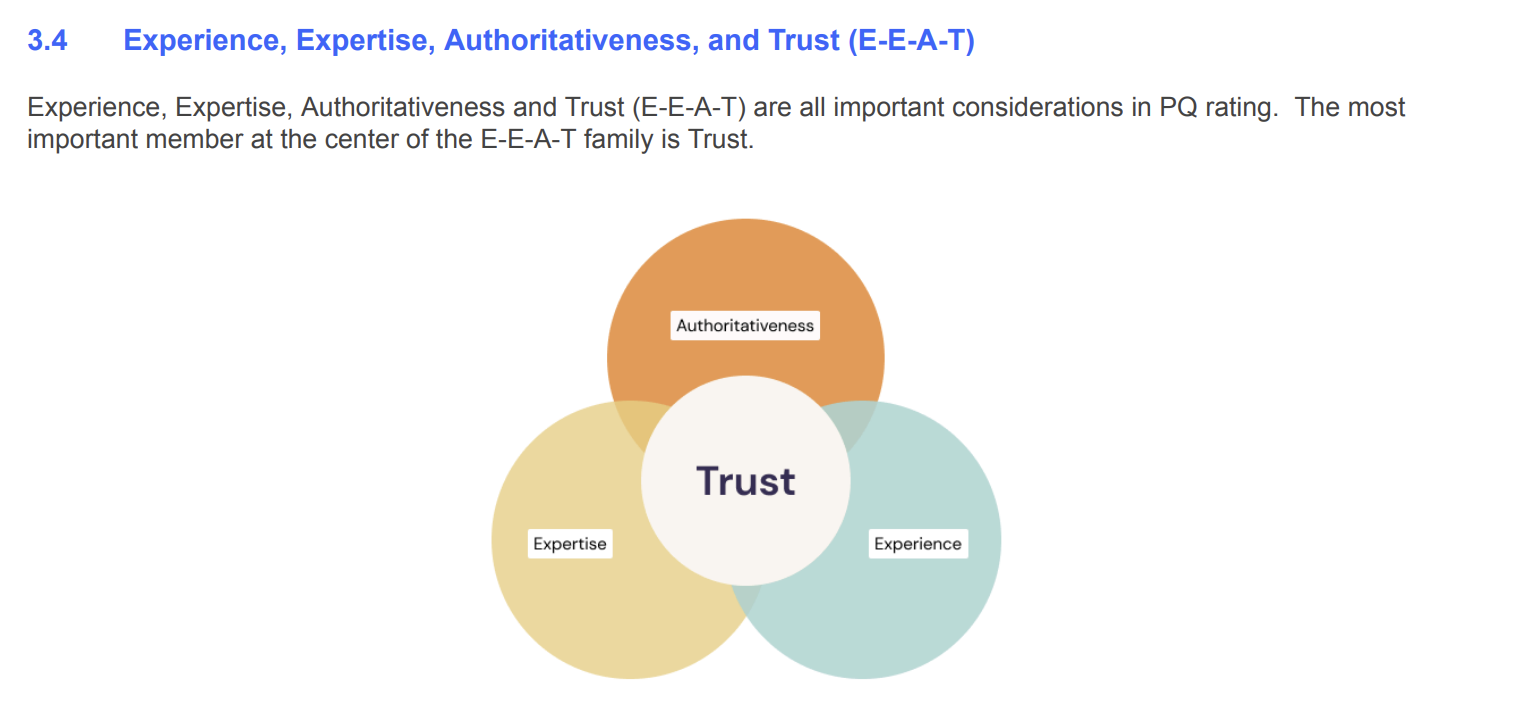
Source: Google’s Search Quality Rater Guidelines, section 3.4.
Trust also gets the most space in the guidelines. In the edition dated 11 September 2025 (182 pages), “trust” and words built on it, from trustworthy to untrustworthy, appear 191 times, against 144 for “expert” and its forms, 116 for “experience” and 49 for “authoritative” and “authority”. A word count is not a ranking formula, but it shows where Google wants its raters’ attention to go.
If you rank poorly despite solid on-page SEO, trust is a good place to look first.
E-E-A-T and AI-Written Content
AI writing tools existed before ChatGPT, but its launch at the end of November 2022 put AI content in front of every marketing team, and many expected Google to treat it as spam.
In February 2023 Google set out its position. Using automation, including AI, to produce content mainly to manipulate rankings breaks its spam policies. Appropriate use of AI does not. What counts is the quality of the result:
“Our focus on the quality of content, rather than how content is produced, is a useful guide that has helped us deliver reliable, high quality results to users for years.”
E-E-A-T is where AI content struggles. A model can summarise what experts have written, but it cannot have first-hand experience of using a product or running a project. Google added Experience to the framework on 15 December 2022, and it is the one part of E-E-A-T that AI cannot supply on its own.
How Do You Get Cited in AI Search (AEO and GEO)?
AEO (answer engine optimisation) and GEO (generative engine optimisation) are about being chosen as a source when AI tools such as ChatGPT, Perplexity and Google’s AI Overviews answer a question. Google says there are no additional requirements or special optimisations for its AI features: the same foundations apply, including the helpful, reliable, people-first content that E-E-A-T describes.
For complex questions, Google’s AI Overviews and AI Mode may use what Google calls query fan-out: running several related searches across subtopics and sources, then drawing on the results to build the answer. That favours pages that cover the related questions thoroughly and credibly.
In practice, that means three things:
- Make your E-E-A-T visible. Show who wrote the page, what experience they have and how you reached your conclusions.
- Answer first, then explain. Open each section with a direct answer of two or three sentences before going into detail. A clear summary is easy to quote.
- Keep guides factual. In our experience, AI tools lean towards neutral, informative material. Save the sales message for your service pages.
| Aspect | Classic SEO | AI search (AEO/GEO) |
|---|---|---|
| Goal | A high position, with a link in the results | To be cited in the answer itself |
| What is assessed | Relevance, links and E-E-A-T | Thorough answers and E-E-A-T |
| Formats that do well | Landing pages built around keywords | Direct answers, summaries and Q&A |
| Tone | Can be more sales-led | Neutral and factual |
The work that lifts you in Google’s ordinary results is the same work Google asks for in its AI features, and in our experience it helps with other AI search tools as well. You do it once and it pays off twice.
How to Improve E-E-A-T: 12 Practical Steps
As an SEO agency, we prefer practical work to theory. What usually works best is a clear audit followed by a priority list, worked through from the top. These are the twelve steps we rely on most to strengthen E-E-A-T and rankings in Google.
1. Put the Essential Pages in Place
It is unusual for a reputable company to have no About page or Contact page, yet we often come across websites whose owners would rather not take phone calls, or who rely on pop-ups to capture leads. That may suit the sales process. For E-E-A-T, it is the wrong call.
Have as many of the pages below as fit your business, and make them thorough and current: having them is not enough. They are not landing pages, but they make the site more credible, and Google’s rater guidelines tell raters to look for About, contact and customer service information. Put them in place before you build more SEO landing pages: credibility first, rankings second.
- About us
- Contact us
- Our history
- The team
- Careers
- Privacy policy
- Cookie policy
- Terms and conditions (plus delivery and returns if you sell online)
- Accreditations, certifications and memberships
Anything that shows you are a real, well-run business helps. If you have partners or support a cause, say so. It is also worth checking your competitors: if several of them have a page you lack, consider adding it.
2. Publish Original, Useful Content
Aim for originality and usefulness in everything you publish. Use ChatGPT if you like, but edit what it produces. Anyone can publish fast, free content, so it no longer sets anyone apart. AI has raised the bar, and doing the job properly still takes time.
Learn from competitors rather than copying them. See what they cover and do it better: if they miss useful angles, original images or video, add them. On competitive keywords, AI-generated content with nothing extra to offer will not hold its position for long.
Everything you publish builds your brand and supports the rankings of the pages around it, old and new. Even when a single article hardly seems worth the effort, take the long view.
3. Make It Easy to Contact You
Give contact details for everyone customers may reasonably need to reach, from sales to support. Google’s quality rater guidelines say contact and customer service information are “extremely important for websites that handle money, such as stores, banks, credit card companies”.
For a B2B firm, a named contact for each department and a real business address go a long way.
4. Cite Reliable Sources
Not every page needs references. But if you use important information from another source, link to it.
If you quote figures from the Office for National Statistics, for example, link to the ONS release. The same goes for research and studies from trade bodies and other organisations in your industry.
5. Build a Brand People Search For
Brand is a bigger job than SEO, and not one for the SEO team alone. It usually takes your marketing, your customer service and outside partners working together.
A strong brand supports your SEO. In our experience, companies that people already search for by name find it easier to rank than less well-known ones.
Good customer service helps too. Positive mentions help, and Google reads what people say about you: its rater guidelines tell raters to look for reviews and reputation information beyond your own site. So reply to your reviews, good and bad.
6. Add Schema Markup for Your Company and Authors
Schema markup is a specialism in its own right. It gives Google precise information in a fixed format, such as names, dates and prices, so that it does not have to infer them from the page.
On WordPress, a plugin such as Yoast or Rank Math generates most of it. On other platforms you can add it to the page templates or through Google Tag Manager.
Schema is also how you build entity-based SEO. Google holds what it knows about people, places and organisations as entities in its Knowledge Graph, and structured data gives it explicit clues about which entities a page is about. The more clearly you connect your company and your authors to profiles that can be verified elsewhere, the easier you are to identify, and to trust.
Your markup must match what the page says, or Google has no reason to rely on it. Useful types include:
- Organization (for the company)
- Person (for authors and experts)
- ProfilePage (for each author’s profile page)
A common mistake is an author name with no link to a real profile. Google’s article documentation recommends linking each author to a page that identifies them and, where that is a profile page on your own site, marking it up as a ProfilePage. sameAs links to the same person’s profiles elsewhere help Google tell authors apart. A minimal example for an author profile page (the names are placeholders):
{
  "@context": "https://schema.org",
  "@type": "ProfilePage",
  "mainEntity": {
    "@type": "Person",
    "name": "Jane Example",
    "jobTitle": "Head of SEO",
    "worksFor": { "@type": "Organization", "name": "Example Ltd" },
    "sameAs": ["https://www.linkedin.com/in/jane-example"]
  }
}
The author is then a verifiable person rather than a loose name.
7. Use Reviews and Other Customer Content
User-generated content (UGC) is anything your customers add: written or video reviews, photographs, comments and forum posts.
It is most common in consumer businesses, especially ecommerce, but B2B firms have their own versions: reviews on independent review sites, testimonials with a name and company attached, and case studies written together with the client.
Used well, it strengthens your E-E-A-T, because it is experience from people other than you. Prospective customers also want to see what others say before they get in touch.
8. Keep Older Pages Up to Date
Pages that were accurate when published but have since fallen behind weaken your E-E-A-T. Not everything needs updating, but most sites have pages that deserve a regular review: when something is no longer true, or when something new has happened that others are already writing about.
SEO is a good example. An article on on-page optimisation from 2021 is of little use today unless someone has updated it.
Clearing out weak content is worth doing, but it is slow and it is not a guaranteed fix. Google says some changes take effect within a few days while others take several months to register, that there is no guarantee your changes will have a noticeable effect, and that “deleting content is a last resort”. Improve or merge thin pages first, and strengthen them with expert review and named authors.
9. Keep Publishing and Stay Current
Staying current in your field matters. Output naturally rises and falls, but if you once updated your site often, published regularly, gathered reviews and earned outside mentions, and then all of it stopped, you are unlikely to look current any more.
This overlaps with step 8, but some pages and subjects need attention more often than others. A page about the Premier League table goes out of date every weekend, while a review of a phone that has already been released may never need touching.
10. Name Your Authors and Show Their Experience
Google wants to know who is behind an article. Its guidance on helpful content asks whether pages carry a byline where one might be expected, and says: “We strongly encourage adding accurate authorship information, such as bylines to content where readers might expect it.”
Give each author’s name, job title, experience and what they know about the subject. The most effective approach is a profile page for each author, marked up with Person schema and sameAs links to profiles that can be verified, as in step 6. Google can then connect the article to a real person rather than an anonymous name. In our experience, a thin author box at the foot of the page, with no link to a real profile, rarely makes a difference.
11. Write for Credible Sites in Your Field
Articles under your own name on respected sites in your industry strengthen the picture of you as someone worth listening to in that field. If an article also earns a link, it can help your rankings directly, not only through E-E-A-T.
Start with people you know, or approach editors directly. If you are good at what you do, you will often be invited to contribute. Put extra care into the first few pieces, since you can point to them when you pitch the next.
The other route is to create material people want to link to: research, original data, case studies, video guides or infographics. It is a longer road, and it needs someone with the skill and the time to produce it, which rules out most people who are busy running a company. Either way, you build credibility as an author and earn outside mentions, often with a link.
12. Keep Your Name, Address and Phone Number Consistent
NAP+W stands for name, address, phone number and website. It matters most for local SEO, but keeping these details accurate everywhere is also part of trust. Directories and listings that still show an old address or the wrong phone number do nothing for Google’s picture of you.
Search Google for each phone number and address you have used, and for your company name. Open every listing you find and correct what you can, and check that your Companies House record matches. Site owners rarely want wrong information on their pages, so most will help, and many directories, including your Google Business Profile, let you make the change yourself.
Where E-E-A-T Fits in Your SEO
Some companies cover E-E-A-T without trying. The twelve steps above are second nature to many established businesses, and those firms usually do well in Google. They are also some of the most rewarding clients to work with, because the foundations are already there.
Where E-E-A-T is weak, the road to organic traffic is longer. Classic landing pages and traditional SEO still produce results, but if you want to lead your market in organic search, E-E-A-T will be part of it.
It works best when trust and SEO are planned together across the whole site, so that these are in place:
- Technical SEO: a fast, secure site that Google can crawl
- Measurement and tracking you can rely on
- Schema markup for the company and its authors
- Named authors with their own profile pages
- Content that is reviewed and kept current
- Landing pages that answer the searcher’s question
E-E-A-T deserves particular attention if:
- your rankings are slowly slipping
- you rank poorly even though you follow the usual SEO advice
Work through the steps that apply to you and give them time. If you would like help, our SEO service covers E-E-A-T alongside the rest of your search work. A good first step is our free search audit, which shows where your site stands today.
Frequently Asked Questions About E-E-A-T
Is E-E-A-T a Ranking Factor?
No. Google says E-E-A-T “isn’t a specific ranking factor”, and there is no E-E-A-T score. Its systems use a mix of signals, such as links, brand mentions and authorship information, to identify content that shows good E-E-A-T, and those signals do affect rankings. Google’s human quality raters use the framework to assess results, but Google says their ratings do not directly affect ranking.
Is E-E-A-T Still Relevant?
Yes. Google still describes trust as the most important part of E-E-A-T, and it says its AI Overviews and AI Mode rest on the same foundations as the rest of Search. As more people also ask AI tools such as ChatGPT and Perplexity for answers, our experience is that credible, people-first content helps there too.
How Do You Improve E-E-A-T?
Start with the essential pages (About, Contact, Privacy policy), name your authors and show their real experience, publish original content, build a brand people search for and keep older pages up to date. Credibility first, rankings second.
What Is the Difference Between E-A-T and E-E-A-T?
The extra E, for Experience. Until December 2022 the framework was E-A-T: expertise, authoritativeness and trustworthiness. Google then added experience to give more weight to first-hand knowledge, which AI-generated content cannot supply on its own.