


Structured data for SEO: a complete guide to schema markup
Structured data earns richer results in Google and helps AI search tools understand your business. What to mark up in 2026, and what no longer pays.

Important: Structured data is no longer only about looking good in Google’s results. It also gives AI answer engines such as ChatGPT, Gemini and Google AI Overviews clear facts about who you are and what you offer.
Structured data can earn you richer search results and, with them, more organic leads. In this post I go through what structured data is, why it is worth the work, which types exist and my best tips.
What this post covers:
- What structured data is and why it matters more now that AI shapes search
- How to build a “consensus layer” that makes your brand clear to LLMs
- Which schema types to prioritise, including merchant listings for ecommerce
- How entity linking with @id and sameAs connects you to Google’s Knowledge Graph
- How to read CTR data correctly now that AI Overviews have changed the picture
If you would like help with your SEO, talk to our SEO agency or start with a free search audit.
What is structured data?
Structured data is used in SEO to describe the content of a page to Google, so it can easily understand what it is crawling. That makes it possible to earn richer listings in Google. And in 2026 it is as much about making yourself understandable to AI models as to Googlebot.
Definition and examples of structured data
Structured data is a way of organising and labelling information on a website so that search engines can easily understand and use it. With structured data you can give search engines detailed information about your website, which can improve how it appears in the search results. Examples include schema.org markup for products, reviews, events, articles and people. You can, for example, specify the price and availability of a product, or the date and venue of an event, which makes it easier for Google to show that information directly in the search results.
What structured data can be used for
Structured data can be used for, among other things:
- Organisations
- People
- Reviews
- FAQs
- Events
- Recipes
- Products
- Articles
The benefits of structured data
Traditionally the answer was simple: structured data earns richer results and more clicks. That still holds, but it isn’t the whole story. In 2024, 58.5 per cent of Google searches in the US and 59.7 per cent in the EU ended without a click to any website, according to SparkToro’s zero-click study of Datos clickstream data. So the aim in 2026 is just as much to build a “consensus layer”: machine-readable facts that make it easy for AI answer engines to understand and cite you, even when nobody clicks.
Below are the main reasons we use structured data for SEO.
Take up more space in Google
Standing out in Google lifts your click-through rate. If your result shows star ratings and an image, for example, people are more likely to click. Google’s own introduction to structured data cites case studies that point the same way: Rotten Tomatoes measured a 25 per cent higher click-through rate on pages with structured data than on pages without, and Nestlé measured an 82 per cent higher click-through rate for pages shown as rich results.
It supports semantic SEO and the consensus layer
Semantic SEO is about understanding the intent and context behind a search. But there is one thing many SEO practitioners miss: ranking first in Google no longer guarantees visibility in AI answers.
AI models such as Gemini, ChatGPT and Perplexity piece together a consensus from several sources. If it isn’t clear to a machine what your company does, who you are and which products you sell, it is harder for the AI to choose you over a competitor whose facts are clear.
The game has shifted from ranking to consensus. You can rank in position one and still be invisible to AI models. LLMs build a consensus across several sources, and structured data makes your entity profile clear enough for AI to retrieve and cite you.
Structured data helps you make that consensus clear.
Structured data and Google AI Overviews
Google AI Overviews (AIO) now appear on many informational searches.
When they do, fewer people click. In Pew Research Center’s study of 900 US adults’ browsing in March 2025, users clicked a traditional search result in 8 per cent of visits where an AI summary appeared, against 15 per cent where none did.
Google says there is no special structured data you need to add to appear in AI Overviews, and that your structured data should match the visible text on the page. Correct markup helps Google understand the page, but it doesn’t replace content that answers the question well.
It supports E-E-A-T
E-E-A-T, which stands for Experience, Expertise, Authoritativeness and Trustworthiness, has become more important in recent years.
Structured data helps you reinforce your credibility and expertise. For example, you can connect the author of a blog post to their social media profiles.
With breadcrumb structured data you make your hierarchy visible directly in Google’s desktop results. It gives users a quick picture of where the page sits in your website’s structure, for example that the page on “Structured data” sits under “Technical SEO”.
Structured data for articles (Article)
News sites and blogs can mark their pages up as articles. It helps Google understand what kind of page it is and, for example, show the right date.
Structured data for products (Product)
Product structured data is essential for ecommerce websites. The old way of doing it, marking up price, availability and brand, is no longer enough.
Today the work is merchant listing markup: shipping details, return policy, sale prices and availability, kept in line with what is actually in stock. Google recommends setting your standard shipping and returns policies once, in Organization markup or in Merchant Center, and overriding them per product only where needed.
Structured data for books (Book)
Publishers and online bookshops can use structured data to promote books. Google’s Book actions let people buy or borrow a book straight from the knowledge panel in Google Search, but the feature is limited to book providers with a wide selection that Google has onboarded and that supply a book feed.
Structured data for FAQs (FAQPage)
Most people will recognise FAQ rich results: questions that expand into answers directly below a search result. Google limited them to well-known government and health websites in 2023 and stopped showing them in Google Search on 7 May 2026.
FAQ and HowTo markup play a different role in 2026 from a few years ago. Neither earns a rich result in Google any more, so the argument for them is answer engine optimisation (AEO).
LLMs and RAG (retrieval-augmented generation) systems extract direct answers from websites to build their own answers. FAQ and HowTo markup describe what each section contains, and clear questions with short, direct answers on the page are easy to extract. Google, however, says no special schema.org markup is needed to appear in its AI features, so treat the markup as a supporting signal and put most of the effort into the visible questions and answers.
Structured data for how-to guides
How-to structured data used to show each step of a step-by-step guide directly in the search results. Google stopped showing how-to rich results on both desktop and mobile in 2023, so the markup no longer earns any extra display in Google Search.
Structured data for video
A video can be marked up with “VideoObject”, and “Clip” can highlight key moments directly in the search results.
Videos often appear for “how to” searches. For videos on YouTube you don’t need markup: Google can pick up key moments from the timestamps in the video description.
Structured data for reviews
There are aggregate ratings and individual reviews. Star ratings make a result stand out, but Google’s review snippet guidelines set clear limits. Review snippets are shown only for certain types, such as products, recipes, books, events, courses and software. You can’t mark up ratings aggregated from other websites, such as your score on a review platform. And if a business controls the reviews about itself, its LocalBusiness or Organization markup won’t earn review stars, even when the reviews come in through a third-party widget.
Structured data for recipes
Recipes are one of the most common uses of structured data. You can specify ingredients, cooking time, nutritional information and step-by-step instructions.
Structured data for courses and events
Courses and events can also be marked up. Event markup can get each event into Google’s event experience in Search, which is available in the UK, provided the event has its own page and a physical location. For courses, Google retired Course info rich results in 2025, while Course list markup is still supported.
Structured data can also be used to create breadcrumbs that help both users and search engines find their way around a website and understand how pages relate to each other. They help Google understand the website’s structure and improve the user experience by showing clearly where the user is. Structured data for a BreadcrumbList looks like this:
{"@context": "https://schema.org","@type": "BreadcrumbList","itemListElement": [{"@type": "ListItem","position": 1,"name": "Home","item": "https://example.com/"},{"@type": "ListItem","position": 2,"name": "Products","item": "https://example.com/products/"},{"@type": "ListItem","position": 3,"name": "Product 1","item": "https://example.com/products/product-1/"}]}
With this type of structured data you make the hierarchy and navigation paths of your website visible in Google’s desktop results.
Entity linking: connect yourself to Google’s Knowledge Graph
Entity linking is about connecting your website to external, authoritative sources such as Wikipedia and Wikidata, so that your identity is unambiguous to the search engines’ knowledge graphs.
From an SEO perspective, an entity is not just a keyword or a phrase. It is an actual concept with a unique identity in a database such as Google’s Knowledge Graph. It is the difference between a search engine guessing what you do and knowing it.
In practice you do this with the @id and sameAs properties in your JSON-LD code:
@id gives your organisation a unique, machine-readable identity. sameAs tells Google that “this is the same entity as the one in these authoritative databases”. It is how you build trust at a technical level, not only through good content.
It is also one of the simpler pieces of structured data to get right, and many competitors haven’t done it.
Nested structured data: build a hierarchy, not islands
Most people think of schema types as isolated islands: one page, one schema. That is a simplified view.
A modern blog article is not one thing. It is an article, written by a specific person, who works for a company, and it may contain a video clip and end with an FAQ section. Nested schema lets you describe that whole hierarchy in a single JSON-LD script, instead of separate blocks scattered around the page.
A simplified example might look like this:
{"@context": "https://schema.org","@graph": [{"@type": "Organization","@id": "https://example.co.uk/#organisation","name": "Example Ltd","url": "https://example.co.uk/"},{"@type": "Person","@id": "https://example.co.uk/#jane-smith","name": "Jane Smith","worksFor": {"@id": "https://example.co.uk/#organisation"}},{"@type": "BlogPosting","headline": "Structured data for SEO","author": {"@id": "https://example.co.uk/#jane-smith"},"publisher": {"@id": "https://example.co.uk/#organisation"},"video": {"@type": "VideoObject","name": "Structured data in five minutes","thumbnailUrl": "https://example.co.uk/video-thumbnail.jpg","uploadDate": "2026-10-01","contentUrl": "https://example.co.uk/video.mp4"}}]}
Googlebot then processes one connected block, rather than looking for separate pieces of code that may describe conflicting entities.
JSON-LD has become the standard format, partly because it handles nested data without touching the HTML. Google recommends JSON-LD where your setup allows it.
Help AI describe your brand correctly
Large language models such as ChatGPT and Gemini hallucinate. They make up facts when clear information is missing, and that can hit your brand directly if the AI confuses you with a competitor or gives the wrong prices and services.
Structured data is one of the most direct ways to reduce that risk, because it states the facts about your business in a form machines can read.
Markup won’t stop hallucinations on its own, but consistent facts in your structured data, on your website and in external profiles leave the models less to guess. It is the difference between the AI knowing what you do and guessing.
How do I add structured data in WordPress?
If you use WordPress, there are plugins that make structured data easy. We recommend Yoast SEO and Rank Math.
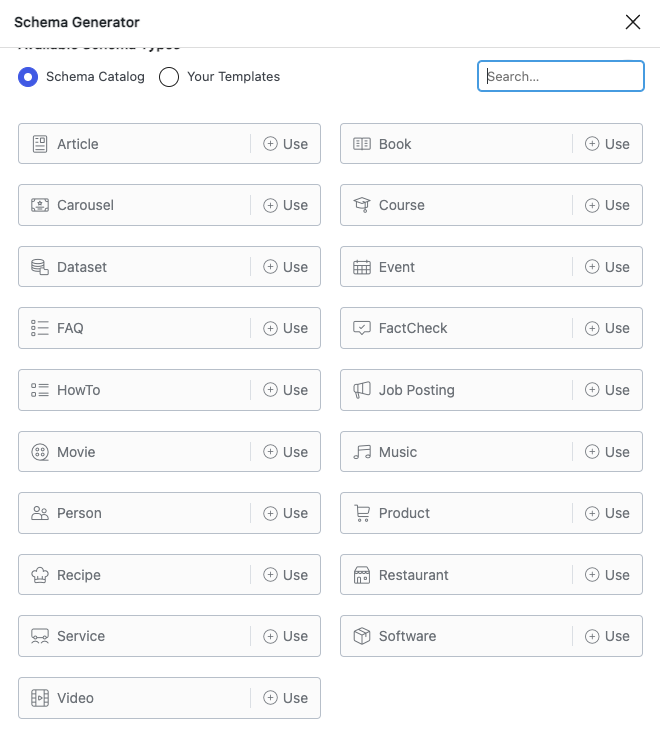
Some structured data is added automatically, and the rest you can create with the plugins’ own guides.
If you want help getting your structured data and the rest of your technical SEO right, start with a free search audit.
Test your structured data
You can check that your structured data is right with Google’s Rich Results Test.
The Schema Markup Validator checks whether your structured data code is valid schema.org markup.
Check for errors in Search Console
For larger websites and regular checks, we recommend Search Console instead. It does require the property to have been set up for a while, so that Google has collected the data.
Use Google Search Console regularly to monitor your structured data. Its reports help you find and fix errors that affect how well Google can read and use your markup.
Common structured data errors
Incorrect or misleading structured data can lead to a manual action from Google. It doesn’t affect how the page ranks in web search, but the page loses its eligibility for rich results. That is why it is worth monitoring your structured data in Google Search Console regularly to find and fix errors. Common problems include:
- Incorrect or missing context
- Incorrect or missing type
- Incorrect or missing property
- Incorrect or missing value
By reviewing and updating your structured data carefully, you make sure it is accurate and relevant, which helps Google understand and use the information as intended.
Measuring and analysing structured data
Measuring structured data calls for a new way of thinking in 2026. The classic question “how much traffic did we get?” no longer gives the full picture.
When an AI Overview appears, fewer people click, as the Pew figures above show. That looks bad in a report. The other side of the coin is that the clicks you do get can convert very differently. In one Seer Interactive client’s data from October 2024 to April 2025, visitors from ChatGPT converted at 15.9 per cent against 1.76 per cent from Google organic search. That is a single website, not a benchmark, but it shows why clicks alone can mislead.
So look at conversion data, not only click data, when you measure the effect of structured data in Search Console and Analytics.
Metrics worth tracking:
- Number of search results showing structured data
- Click-through rate (CTR) for search results showing structured data
- Average position for search results showing structured data
- Conversion rate for organic search traffic and for traffic from AI tools, side by side
Analysing these metrics shows you how well your structured data is working, so you can make the adjustments needed to improve your website’s visibility and performance.
How do search engines see your website?
Search engines see websites in a fundamentally different way from people. Where a person takes in layout, colours, images and style, search engines focus on the underlying HTML and other technical elements. Structured data helps search engines understand the content, which can lead to better visibility in the search results.
Be thorough and use the right structured data
- Keep the information up to date so Google can trust it
- Include everything that is relevant, but don’t pad it with unnecessary content
- Use the JSON-LD format
Google often changes its recommendations, and that will continue, not least with AI Overviews.
When SEO practitioners spot a loophole in structured data, it tends to be overused within a short time and Google has to change its guidelines. FAQ rich results are a good example: limited in 2023 and gone in 2026. If a loophole appears, by all means use it, but if it seems too good to be true, Google will probably adjust it.