


Topical authority: what it is and how to build it in 2026
When cited in AI Overviews, brands get 35 per cent more organic clicks (Seer Interactive, 2025). Here is how to build that authority, step by step.

Topical authority is a measure of how comprehensive and trustworthy a website is on a specific subject, both in Google’s eyes and to AI models such as ChatGPT and Perplexity. You build it by covering every semantic part of a topic, connecting those parts as entities and backing it all up with a track record of reliability.
In this article we answer:
- What topical authority is and why it decides whether you are visible in 2026
- The formula behind authority (topical coverage + historical data)
- How to structure content to be cited in AI Overviews
- How to measure topical authority in practice
We are an SEO agency with 14 years in search, and this is the approach we use to help companies rank, and be cited, for the topics that bring in business.
The key points
- Topical authority = topical coverage + historical data (a practitioner model associated with the SEO consultant Koray Tuğberk Gübür)
- On informational queries where AI Overviews appear, organic click-through rates fell by 61 per cent between June 2024 and September 2025 (Seer Interactive, 2025)
- Seer suggests that being cited may reflect underlying brand authority and E-E-A-T signals, though it could not prove this with its data
- Brands cited in AI Overviews get 35 per cent more organic clicks than when they are not cited (Seer Interactive, 2025)
Topical authority checklist for 2026
- Stick to a limited number of topics
- Start by publishing content that proves your expertise
- Build content in three tiers: pillar, cluster, supporting entities
- Cluster keywords that share the same search intent
- Stay within established facts
- Add real value and new perspectives
- Optimise for zero-click searches with an “extraction architecture” (a TL;DR and direct answers at the start of paragraphs)
- Use schema markup to map relationships between entities, not just for FAQs
- Monitor citation frequency in ChatGPT and Perplexity, not just classic rankings
- Always add first-hand data or your own expertise to AI-generated content
- Update old posts
- Build cross-channel authority by appearing on relevant sites in your niche
- Remove irrelevant pages from your website
- Improve your crawl budget so that Google can index you more easily
What is topical authority in SEO?
Topical authority is a measure of your website’s expertise in a subject. If you stick to one subject, cover it with both breadth and depth, and users like your content, you have more topical authority in Google’s eyes.
Topical authority in 2026: AI Overviews and zero-click searches change the game
On informational queries where AI Overviews appear, organic click-through rates fell by 61 per cent between June 2024 and September 2025 (Seer Interactive, 2025). At the same time, almost 60 per cent of Google searches end without the user clicking on anything (SparkToro, 2024). That is where topical authority comes in.
According to the same Seer study, brands cited as a source in an AI Overview get 35 per cent more organic clicks than when they are not cited. Seer is careful to say this is a correlation, not proof that the citation causes the extra clicks, and suggests that both may reflect underlying brand authority and E-E-A-T. Either way, the clicks that remain are going to the brands that AI answers choose to cite, and backlinks alone will not put you among them.
This is the shift you need to understand:
| Then (classic SEO) | Now (2026) |
|---|---|
| Win position 1, get the click | Be cited as a source in an AI Overview |
| Domain authority from backlinks | Topical authority from coverage |
| Rank for individual keywords | Cover whole subject areas as entities |
| CTR measured in clicks | CTR + citation frequency in AI models |
For your business, this means rethinking what you measure and how you write. Being mentioned is the new ranking.
Why is it important to create content for topical authority?
Topical authority matters because Google cannot judge individual facts in isolation. The search engine leans on consensus, user experience signals and your earlier pages when it assesses the next one.
If you have already proven your expertise in an area, new articles on the same subject are more likely to rank well from the start. This creates a snowball effect in which established authority strengthens future content.
If you run an online running shoe shop and prove your expertise across most of the subject, you are more likely to rank for your important category pages, which is where you make your money.
We have seen good results with clients by optimising the XML sitemap and removing thin pages and keyword cannibalisation. Focusing on fewer, well-written pages that cluster keywords with the same search intent improves both the crawl budget and the site’s overall authority.
In other words, irrelevant content can hurt your SEO more than it helps.
A concrete example: who would you rather buy from?
- Online shop 1: Demonstrates expertise in running technique and advises on which shoes suit different running styles.
- Online shop 2: Lists products without any extra insight.
All else being equal, who would you buy from? For me, option 1 is a given, because it gives me more confidence in the brand and its products.
The same reasoning applies to how Google assesses pages: those offering in-depth, expert content often rank higher. That is one reason why topical authority works in practice, both for ranking for keywords and for increasing your sales.
The formula behind topical authority: coverage + track record
Topical authority can be described as topical coverage + historical data. It is a practitioner model rather than a metric Google publishes, but this simple formula says something important: you cannot build authority in a month, and you cannot rank broadly just because you have covered everything at once.
Topical authority = topical coverage + historical data. A source has to cover every semantic variation at the lowest possible cost of retrieval.
The two components work like this:
- Topical coverage: How many semantic variations of a topic you actually cover. Every question, every subtopic, every entity.
- Historical data: How consistently you have provided accurate information in the niche over time. User signals, the brand’s reputation and how long you have stayed true to the subject.
What this means for your business: do not broaden your subject area until you dominate the first one. Topical coverage without a track record gives rankings that wobble. A track record without coverage leaves you with a website that ranks narrowly. It is the combination that lets you rank steadily and be cited in AI answers.
Domain authority vs topical authority: which carries more weight?
In niche areas, topical authority beats domain authority. In our view, that is the single most important insight for smaller businesses in 2026.
Classic SEO often measures authority through backlinks and Domain Rating (DR). Topical authority instead measures how deeply and broadly you have covered a subject. The difference becomes clear in practice:
- A specialist site with a modest Domain Rating can compete with far larger sites on the searches within its niche
- The large sites have the links and the breadth, but they rarely cover a narrow subject in the same depth
- The specialist wins through deep coverage of its own topic, not through backlinks
Is a Domain Authority of 40 good? Yes, if your topical coverage matches the niche you are aiming for. No, if you are trying to compete broadly against large websites with thousands of backlinks. As a smaller business, choose a niche you can dominate, not one you hope to be seen in.
Originality and E-E-A-T are the key to AI citations in 2026
In our assessment, originality and strong E-E-A-T are what decide whether you are cited in AI answers. Without them, it is hard to appear in ChatGPT, Perplexity or Google’s AI Overviews at all.
This is what actually works:
- Stay within what Google expects of the subject, so that “enough of it checks out”
- Then contribute original research, your own data or insights that cannot be found anywhere else
- Show first-hand knowledge: images from your own projects, case studies from your own clients, real failures
- Do not use AI-generated content as it is. Always add your own data, examples or expertise
- Make the author’s expertise clear: name, job title, experience and connections to other authorities in the niche
E-E-A-T works as a gatekeeper, not a booster. Without authority, it is hard to be visible in AI search, however well you rank.
Publishing nothing but one-click AI-generated content will not win against Google’s and OpenAI’s own answers. Originality is not an extra. It is the price of being visible at all in search in the AI era.
Create new pages or update existing ones for topical authority?
At the start of an SEO strategy, creating new pages and starting to prove your expertise in an area is often more important for your topical authority. But as the website grows and becomes established, maintaining and updating the content you already have matters at least as much.
If old pages lose relevance or quality over time, you risk losing Google’s trust. That can affect how the search engine judges your website as a whole, which in turn can mean weaker rankings for newer pages too. We have seen that websites which regularly update and improve their existing content tend to keep their authority and rank better over time.
Finding the balance between creating new content and improving what exists is crucial for long-term SEO.
Cross-channel authority
Once you have built up knowledge on your own website, the next step is to be visible on other websites that are relevant to your niche.
- Write guest posts for relevant sites in your niche
- Appear on podcasts and share your expertise
- Speak at relevant events (and make sure Google can see it)
- Take part in industry awards and competitions where they exist
- Can you earn certifications and mentions from them?
- Are there lists and other relevant websites in your field where all your competitors appear, but you do not?
- If you have the means, a strong approach is to create a YouTube video, share it on LinkedIn with a short summary and link to a blog post that contains the video and a written version of its content.
How to build topical authority in practice
Build content in three tiers (the topical authority pyramid)
A common way to describe the structure is as a pyramid with three tiers. It is the architecture that signals depth to both Google and AI models:
- Tier 1, pillar pages: Broad hub pages that cover a whole subject at a high level, often running to several thousand words. Example: “The complete guide to SEO”.
- Tier 2, cluster content: In-depth articles on specific subtopics that link back to the pillar page.
- Tier 3, supporting entities & FAQs: Pages that answer long-tail questions and cover the outermost nodes of the subject.
Three tiers, a clear hierarchy and internal links pointing upwards: that is the architecture.
- Create a topical map: Identify all the main topics and subtopics. Stick to a limited number of topics, depending on how ambitious you are.
- A concrete example: A gardening website might have “A guide to looking after your garden” as its pillar content, with articles on “planting roses”, “caring for perennials” and “the best garden tools” as clusters.
- Identify keywords: Find the keywords that share the same search intent and belong on the same page.
- Create the content: Start producing well-written content in your niche.
- Update what exists: Once you are well established, updating and improving existing pages is as important as creating new ones.
- Cross-channel authority: Start working externally in the same niche. This can happen at roughly the same time as you start updating existing pages.
4 concepts that matter in topical authority
- Frequency: How often do you create new pages and update existing ones?
- Information gain: Do you add to Google’s knowledge (its Knowledge Graph) in a subject area?
- Cost of retrieval: The idea is that Google wants to save money and processing power. Pages with semantic consistency, clean HTML and clear relationships between entities cost less to interpret, which gives them an algorithmic advantage. In practice: use consistent language for your core entities, avoid ambiguity and let your internal links show the hierarchy clearly.
- Information responsiveness: How well does your information match Google’s knowledge (its Knowledge Graph)? Because Google cannot verify individual facts on their own, it needs consensus to back up what you say. At the same time, Google has put more emphasis on originality, so you need both.
Visualise keywords with Screaming Frog
Site-wide n-grams give you a visual picture of which keywords and topics are mentioned most often on a website. My guide to Screaming Frog shows how to do this.
You can use it on your own site and to compare yourself with competitors.
Measuring topical authority
Measuring topical authority is complex, and no tool can quantify it precisely. Instead, you can use a combination of tools and techniques to estimate your authority and improve it.
1. Compare which keywords your competitors appear for
Most SEO tools can compare where you appear with where your competitors appear. It might look like this, for example:
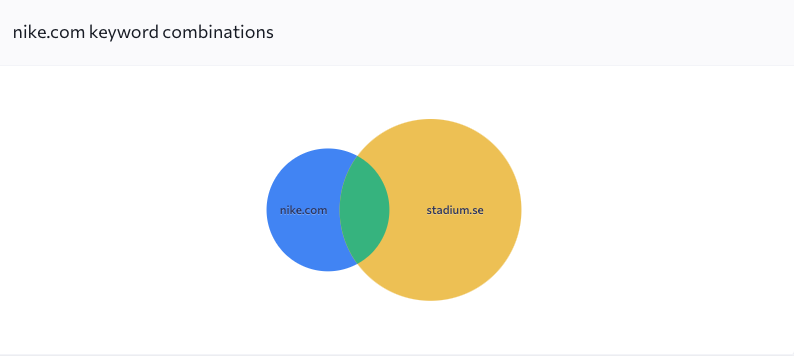
You don’t need to appear for everything they appear for, and shouldn’t try. But it works as a source of ideas for the articles you are missing.
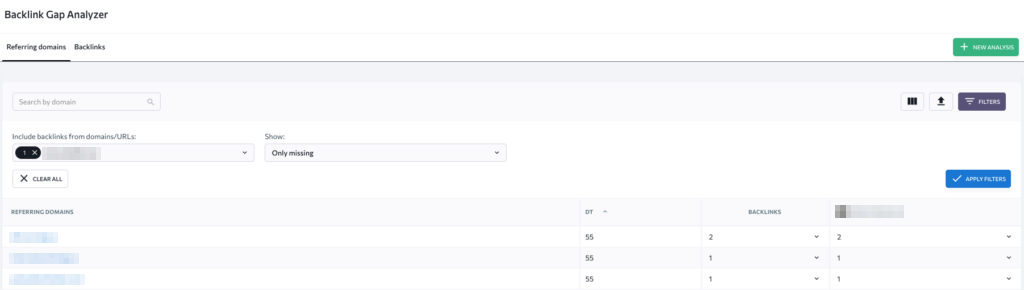
2. Compare external links
Analyse the links your competitors have. Which relevant websites feature them where you could appear too?
3. Compare n-grams
As with the Screaming Frog tip above, you can analyse which keywords are most closely associated with a website. If you are too far from the core of the subject, and from the sites that rank above you, you should adjust.
4. Citation frequency in AI tools
Citation frequency measures how often your brand is named as a source in ChatGPT, Perplexity and Google’s AI Overviews. It is the new rank tracking, for a world in which almost 60 per cent of Google searches end without a click.
The value is concrete: when a buyer asks an AI tool about your field, the brands named in the answer are the ones that get considered. Original data, such as an annual industry report, gives AI models a reason to name you.
What to do:
- Search for your most important keywords in ChatGPT, Perplexity and Gemini once a week. Note whether you are mentioned and in what context
- Track how the number of citations develops over time
- Produce original data, surveys or frameworks that are worth citing. That is what AI models look for in a source
Topical authority in summary
If you understand this, you have understood topical authority:
- Do not take on more subject areas than you can keep up to date
- Create genuinely useful, original content
- Balance creating new content, updating what exists and being visible elsewhere
- Cut what you do not need
- Measure both rankings and citations in AI models, not just clicks
If you would like help with your topical authority strategy, do get in touch, or start with a free search audit of your site.