


How Long Does SEO Take? And How to Speed Up the Results
SEO usually takes three to twelve months before traffic moves. Here is what decides the pace, and what you can do to speed it up.

SEO generally takes 3–12 months before you see clear results in the form of more traffic and better rankings. For new websites in low-competition niches it can move faster, while stable top rankings in competitive sectors often demand 6–24 months of deliberate work before the real commercial impact lands.
How long does SEO take? The eternal question we are going to try to answer.
- The short answer: 3–12 months
- The long answer: it depends (how long is a piece of string?)
Beyond giving a fuller answer on how long SEO takes, we will give you concrete tips on how to speed up the results.
In this post we will answer:
- What actually determines how quickly you see results
- The difference between early traffic and real commercial impact
- Concrete tips for speeding up the process
- How core updates affect the timeline
We are a search marketing agency with 14 years of SEO experience. If you are reading this post, you could well be on the right track to doubling your sales.
The key points in brief
- SEO usually delivers visible results after 3–12 months.
- Stable top rankings in competitive sectors typically take 6–24 months before the commercial impact lands.
- Your effort and your quality weigh heavier than how long you have been at it.
- Google core updates are often the big turning points for rankings.
- Established, authoritative domains can rank new content within hours – new websites face a serious headwind to start with.
What is your goal?
The timeline for SEO depends entirely on the goal you are working towards. The first question is obvious, but it has to be asked: what is your goal with SEO? If the goal is to rank for a single keyword, SEO can move quickly. If the goal is to hold the most organic traffic in your sector and be able to drop paid channels altogether to lift your profitability, it comes down entirely to the competition.
As a rule, you get a result the day after something is indexed. SEO is a long-term process where the timeline for results depends on several factors.
So the real question is: how long does it take for SEO to move into profit?
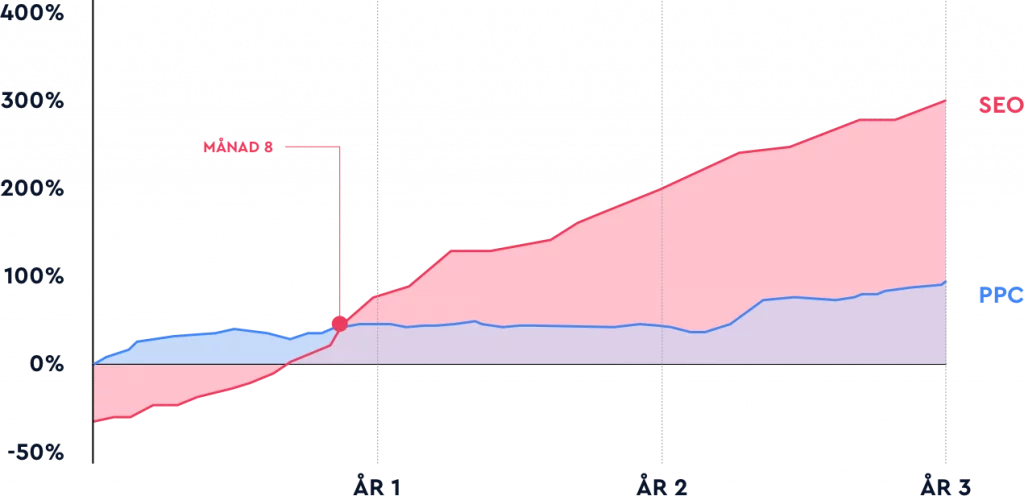
How long does SEO take to become profitable? Below is an illustration with ROI on the y-axis.
The difference between early traffic and commercial impact
It is easy to confuse when the traffic arrives with when the money arrives. Early rankings on long-tail keywords can show up within 3–6 months, but that does not mean your cash flow has changed. Real commercial impact – where SEO replaces or complements paid channels on profitability – lands more often in the 6–24 month range.
The measurement you should be making is not “are we visible?” but “are we making money from the traffic?”. That is where SEO gets interesting as a business case. You can rank for irrelevant keywords for months without a single pound coming in.
Competition is the decisive factor
Competition is the single biggest factor in how long SEO takes. What separates SEO from other channels is that only one result sits at the very top.
If you have important keywords you need to be visible for, the work runs until further notice, even if the volume of it can drop over time.
If competition is low, you can wind the work down to almost nothing once you have won. But SEO has become so popular that nearly every sector, especially on the important keywords, has other SEO specialists competing with you. It is an ongoing process that takes patience and strategic work.
The sandbox for new websites
Google has a sandbox for new websites that acts as a filter to screen out spam. You have to get past that filter before you are indexed and start seeing results.
It can take weeks or months to build up enough trust for full indexing.
Here the gap between a new domain and an established one is brutal. Established domains with strong accumulated trust can rank new content in a matter of hours – Google already trusts them and does not need to verify them over and over. A new website faces the opposite headwind: even good content can sit invisible for weeks before Google decides to trust you.
If you are new, that means you should not measure yourself against established competitors in the first few months. You are not playing the same game.
Effort matters more than time itself
Time is not a ranking factor – what you do with the time is. The days pass at the same speed for everyone. In that sense, time is an irrelevant factor. It is what you do that counts. Waiting your way forward, or blaming the fact that others rank better because they have been around longer, will not help you.
To work effectively with SEO, we recommend our SEO strategy.
Bear in mind that time can also work against you. Websites that stand still can fall, because Google decides they are no longer as relevant.
How long does it take Google to find what I have done?
Google finds new pages within anything from a few hours to several weeks – depending on how often it visits your website. Google does not work in real time. Google is a for-profit company (possibly the smartest thing I have ever said?). It only spends resources visiting you if it believes something new may have appeared.
If you have not worked with SEO before, or have not updated the website regularly, it is not unusual for us to see indexing take 4–10+ weeks.
To begin with, you may need to ask Google to index the new pages you create. The easiest way to do that is through Google Search Console.

If you do not already have a Search Console account, you can create one here.
Slow indexing usually correlates with weaker rankings. That is where crawl budget comes into the picture.
Once you have kept activity high on the website for a while, Google will prioritise you more – provided it likes what you are doing. At that point you no longer need to ping pages; it is better to let Google find them naturally.
Bear in mind that if you ping a page, Google generally only finds that one page. It does not pick up the internal links pointing to it, so the full effect is delayed. The end result is no better, but you can speed up the moment Google changes its picture of you and registers that something is happening.
Google core updates – what do they mean for the timeline?
Google core updates are the big turning points where rankings jump – and they have become more continuous than they used to be. Plenty of people know that Google’s algorithm changes daily. Those are generally very small updates that matter little to the bigger picture.
Larger core updates used to arrive in a clear rhythm of 2–4 a year. More recently, Google has moved towards more continuous updating – some changes roll out gradually over months rather than as distinct events. That means you can no longer “wait out” an update the way you once could. Check what is live on the Google Search Status Dashboard to see what is rolling out right now.
We love core updates. Why?
We are driven by producing SEO results. But you rarely get the full effect of your work straight away.
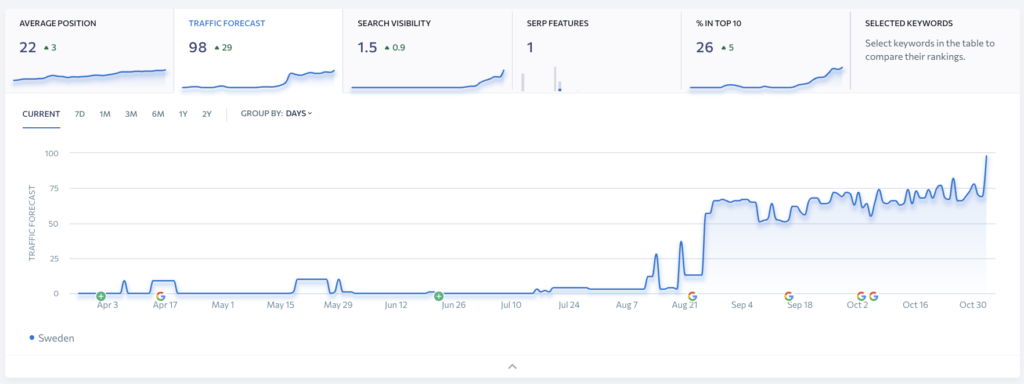
Results jump far more around a core update. If you have done everything right, you can come out of one as a big winner.
Below is an example of one of our clients whose results took off after an update (the Google logo marks the different updates; the one around 21 August is a core update).
Make sure that ahead of the next update you get Google to change its mind about you. The aim is to become the sector expert with a genuinely strong website that users love.
If you want to fly on Google too, you are very welcome to get in touch with an experienced SEO agency. We work with companies right across the UK.
What can I do to speed up SEO results?
- Keep a higher tempo than your competitors, at higher quality
- Update old content
- Understand how Google is changing (so future updates favour you more than the others)
- Do not move too fast and too obviously at individual keywords
- Mix several different ranking factors – on-site and off-site, for example
- Do the safe things as quickly as possible – load time, technical errors and better UX, for example
Common misconceptions and expectations
When it comes to SEO there are several common misconceptions that set unrealistic expectations among website owners:
- That SEO results are immediate: SEO is a long-term process that takes patience and deliberate work.
- That SEO is a simple process: SEO is a complex process that requires a deep understanding of search engine algorithms and user behaviour.
- That SEO is a one-off exercise: SEO is a continuous process that requires ongoing optimisation and adjustment to hold and improve the website’s rankings.
How long does it take to recover if Google has penalised me?
In cases where Google has penalised you (you lose rankings quickly without having done anything yourself), there are two things you can do:
- Hope it sorts itself out
- Start playing by the rules
Unfortunately I cannot give a short answer on what to do if you are penalised. But it usually revolves around aggressive external links with exact-match anchor text, or over-optimisation of your on-page SEO.
- Improve the user experience
- Fix your technical SEO
- Update old content
- Delete thin pages and the ones that contribute nothing
- Create quality content that gives the user value
Once you have done this for long enough, and Google has also seen all the good work you have done, you generally have to wait for Google’s next core update before things loosen up.
Something I have found works well is making one genuinely large change. That could be an entirely new website, or several changes at once. It forces Google to re-evaluate you.
What happens if I stop doing SEO?
To begin with: nothing.
Over time: keyword rankings will fall. Others will catch up and build a lead over you.
How quickly does that happen? It depends on the competition, how big a lead you have, and how important it is in your sector that things get updated.
It is easier to ride the wave than to keep starting over.
Does the age of the domain matter?
Judging by the Google leak in May 2024, domain age does appear to be recorded by Google. How much it matters, though, is not clear.
As a rule, what counts is the time since you were indexed for something, and the trust accumulated since.
So URLs that have been indexed for a long time with old content do not necessarily rank better than a new website with new content.
Bear in mind, as with everything else: it depends.
A blog post about SEO from 2018 is no longer interesting. There, updated content matters more. Other, more static subjects do not have to be updated, and in those cases an older page can be the stronger option.
Is time a ranking factor?
Time in itself is not a strong ranking factor in SEO. How long SEO takes comes down to effort and history.
With time, though, you do tend to accumulate more trust. So URLs indexed over a longer period with old content do not necessarily rank better than a new website with fresh content.
History can make it go faster
Serious companies are often unknowingly good at SEO. They have accumulated value, and Google understands what they do without them having over-optimised anything.
SEO moves at its fastest when the company is established but simply has not used the power it already holds.
The longer your history, the more likely it is that you have built up greater SEO value. But time in itself is not what we look at most – it is what is already there, and how Google responds to the things we do.
Below we go through two different approaches, depending on whether you have a new or an old website.
Strategy if you have a new website
If you have a new website, make haste slowly. Do not go straight at traditional SEO and cram in keywords. Focus instead on:
- Aim at easier keywords and win there first
- Build up E-E-A-T for SEO
- Start blogging and build trust
- Establish yourself as an expert in your field
- Earn a handful of external links from relevant, strong websites
Strategy if you have an old website
If you have been in the sector a long time but have not worked with SEO, there is sometimes more to gain straight away.
The priorities we see for speeding up your rankings are:
- Internal links – important SEO landing pages should have several relevant internal links pointing at them
- Resolve internal competition – clean up pages that compete with each other
- Technical SEO – this is where you find the larger errors that make a big difference
- Create SEO landing pages for keywords you have not written about
What makes SEO slow is also its strength
The fact that SEO takes time is only a problem at the start.
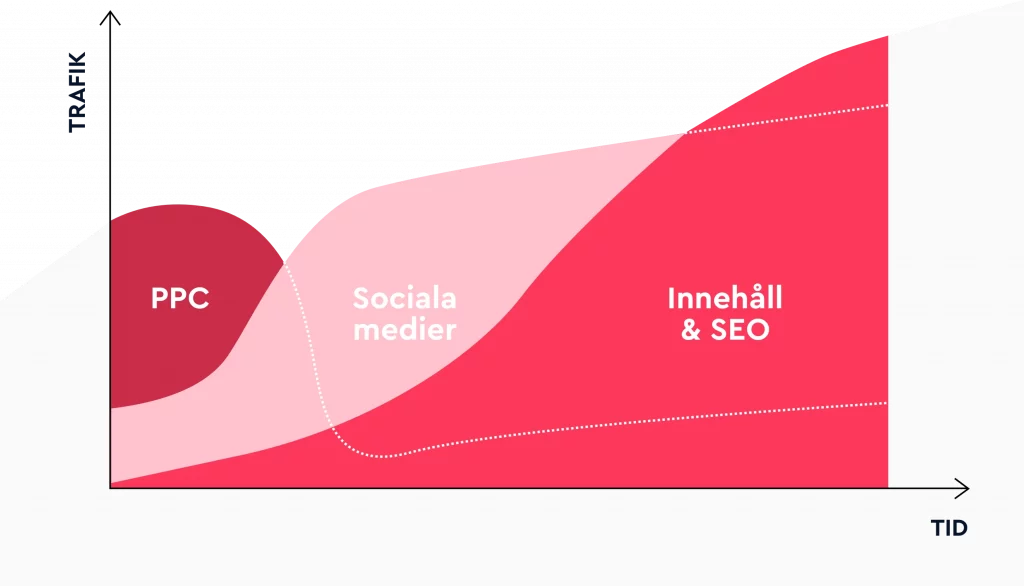
Over time, once you have worked with SEO for longer, the accumulated value becomes a moat of its own – one that makes it hard for new companies to run past you.
- Your effort matters more than time itself
- Do not rush at large, difficult keywords
- Do not over-optimise – it will not go any faster
- Understand Google and start looking forward to the next Google core update
- The fact that it takes time is also one of the biggest advantages of SEO
Because only one result can rank at the very top, the win goes to whoever does the work better than everyone else. Many will never win, because they are always one (or several) steps behind.
We hope that answered how long SEO takes, and what you can do to speed up the results.
When does SEO start to become profitable?
SEO usually becomes profitable somewhere between month 6 and month 18 – depending on your starting point, the competition and how much you invest. An established company that has started optimising its existing website generally sees a positive return sooner than a brand new company that has to build authority from zero.
Get help with your SEO
If you would like help with your SEO, and an estimate of how long it would take in your particular case, you are more than welcome to get in touch. We are an SEO agency working with clients across the UK.
Get a free SEO audit from Nils – within 24 hours.