


What Are Google AI Overviews and How Do You Optimise for Them?
Google cites pages in AI Overviews, and what gets cited is not always what ranks. Here is how to be the source it quotes.

AI is no longer the future. In August 2024, Google rolled out AI Overviews in the UK, and it changed the rules of the game for how we work with SEO.
Today, AI Overviews appear in 55% of all searches. It is no longer a question of “will this affect us?” but “how do we adapt?”.
In this post I go through what Google AI Overviews are, how they affect your visibility and – above all – the concrete strategies for winning citations in the AI answers.
What are Google AI Overviews?
Google AI Overviews is Google’s AI-driven answer feature, which presents summarised answers directly in the search results. The feature was introduced as an experiment (then called SGE – Search Generative Experience) at Google I/O 2023, but launched officially in the UK in August 2024.
The difference compared with earlier featured snippets? AI Overviews synthesise information from several sources and create a new, coherent answer – instead of simply showing an extract from a single page.
Google AI Overviews will fundamentally change how Google looks and works. Above the current results you already find things such as the featured snippet. These have shrunk in scope, and the space is instead dominated by an AI-generated answer right at the top.
Google has become more interactive for users. Instead of asking new questions, you can ask follow-up questions and modify the answer.
Ultimately Google has become a better search engine for the user, which has led to even more people using it to find what they need.
Below are two examples from Google’s page about generative AI in the search results.
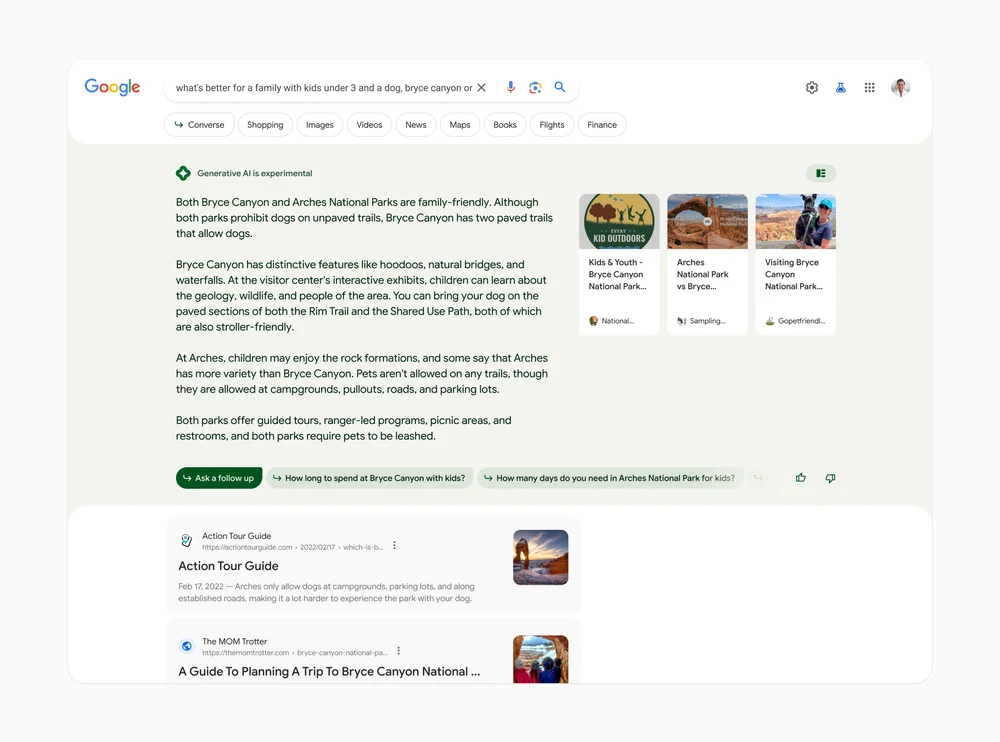
The image above shows how Google gives a relevant answer to a relatively simple question.
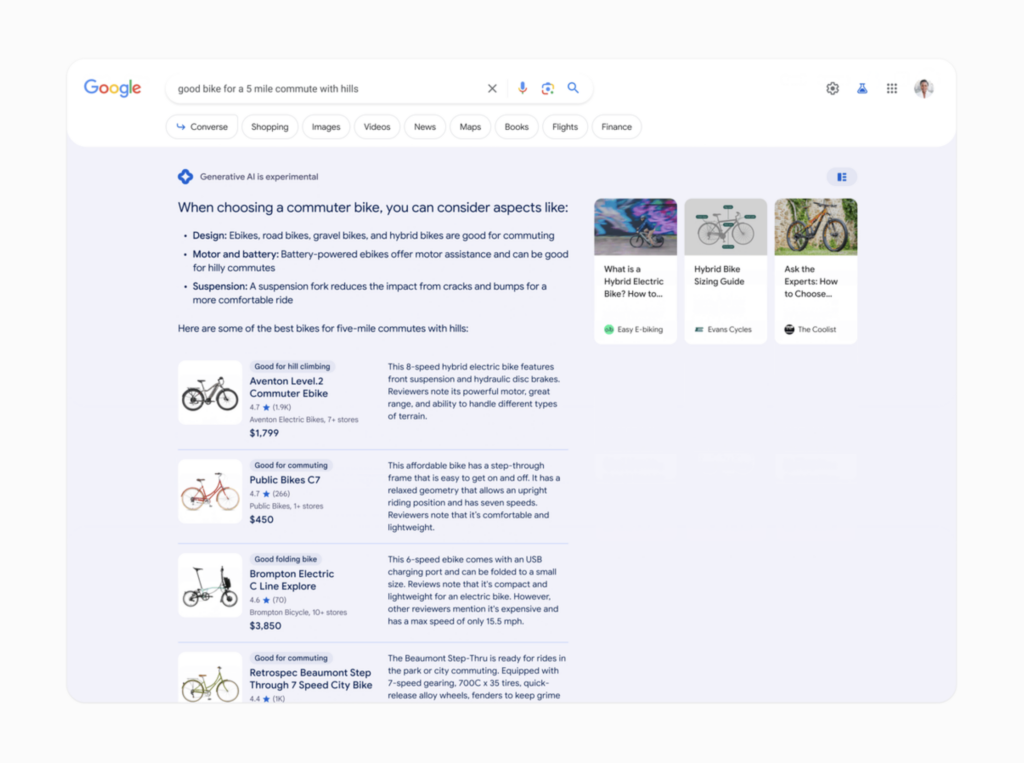
The image above is an example of how products can be included.
How AI Overviews work technically
Google uses large language models (LLMs) to create AI Overviews. The system combines information from several sources and generates dynamic answers based on the user’s question.
The important thing to understand: the AI no longer ranks pages – it cites them. 99.5% of all sources cited in AI Overviews come from the organic top 10. Classic SEO is still the foundation, but it is no longer enough to simply sit on page one.
The average AI answer is 254 words long and draws information from three to five sources. If you are not one of them, you are invisible.
Global rollout and the UK
Google AI Overviews launched first in the US in May 2024. During the autumn of 2024 the feature expanded to more than 100 countries and reached over a billion users.
The UK got access to AI Overviews in August 2024, in the first wave of countries after the US. Since then the feature has stabilised and now appears in 55% of all searches – which makes it the new standard for how people find information.
What do Google AI Overviews mean for SEO?
Data from 2026 shows that the rules have changed from traditional ranking to citation. It is no longer only about being visible – it is about being the source Google chooses to recommend.
The user journey is changing
58.5% of all searches now end without a click (zero-click). That is an increase on previous years, and the trend continues upwards.
More and more searches begin and end on Google without a single click through to the people who create the content. This mainly affects informational searches. If you want to call a tradesperson, you will eventually want their email, phone number or contact form, either on Google or via the website. If you are buying a product, you do not buy it from Google, you buy it from the online shop.
But here is the interesting part: visitors who arrive from AI platforms spend 68% more time on the site. That is quality over quantity. Fewer clicks, but the people who do click are more engaged.
If you are cited in the AI answer, your CTR rises by 35%. That is an enormous upside – but only if you win the citation.
Organic traffic is falling – but not for everyone
Organic click-through rate has fallen by 34.5% for searches where AI Overviews appear. That is a significant change.
But: those cited in the AI answer see an increase. The rest lose out.
This is the new reality. Either you are the source, or you are invisible.
Focus on transactional search intent
Because the number of zero-click searches is rising, focus should shift further towards keywords with transactional search intent, such as product and service pages. This has not really changed, other than that it has become even more important.
88% of AI Overviews-triggered searches are informational. That means product pages and service pages still get clicks – but that guides and educational content more often stay on Google.
Diversify your content strategy. Create content that requires interaction – calculators, templates, tools – the things AI cannot replace.
Google Ads is here to stay
Google earns too much money from its advertising not to build Google Ads placements into this in some form. There will probably be, and will need to be, organic placements that resemble those – but, as now, below the ads.
For ecommerce it is extra important: 61.7% of ecommerce searches trigger AI Shopping. Products have to be optimised for the Shopping Graph to be visible. Good product copy is no longer enough – structured data and clear product attributes are decisive.
The way people search will change
Google is already good at understanding search intent through semantic SEO. Search queries from users will probably become more specific.
So we may no longer see the dominance of the 1–4 word searches we make today. It is more likely that you need to be the strongest search result for whatever your customers actually want.
The generative experience gives the user what they are looking for. If someone searches for “list the top three carpenters in Manchester”, that is exactly what it will do. It also becomes easier to add qualifying words to define precisely what you are looking for.
Local SEO matters more than ever
More than 40% of searches have a local connection. Google Business Profile (GBP) is a primary data source for AI Overviews.
If you run a local business – a restaurant, a trades business, a shop – GBP optimisation matters. It is how the AI finds you.
Make sure that:
- Your GBP is complete with opening hours, images and reviews
- You have LocalBusiness structured data on the website
- You are mentioned on local sites and industry directories (Citation Velocity)
Strategies for Generative Engine Optimisation (GEO)
GEO (Generative Engine Optimisation) is the new SEO. It is no longer only about ranking – it is about being cited.
Here are the concrete strategies that work in 2026.
1. Atomic answers – answer immediately
To be cited, the answer has to appear within the first 150 words. This is known as the BLUF principle (Bottom Line Up Front).
The AI looks for “atomic answers” – short, definitive answers that can be extracted directly. The average AI answer is 254 words, which means your answer has to be compact and clear.
How to do it:
- Identify the main question for each page
- Place the answer in the first paragraph after the intro
- Use the format: “[Concept] is [definition] that [benefit]”
- Follow up with the detail further down
Example: “Structured data is code that helps Google understand the content on your website, which raises the chance of appearing in AI Overviews.”
2. Structured data – the language of AI
Structured data is no longer nice-to-have – it is a requirement for being cited.
Prioritise these schema types:
- FAQPage: for frequently asked questions (raises the chance of citation 3.2 times)
- HowTo: for step-by-step guides
- Article with `author` and `dateModified`: for E-E-A-T
- ImageObject with a detailed `caption`: to appear in AI carousels
- LocalBusiness: for local businesses
Technical detail: use JSON-LD (not Microdata). Google prefers it and it is easier to maintain.
If you do not have the technical skills in-house, an SEO agency can help you implement this correctly.
3. Digital PR – the new technical SEO
Citation Velocity – how often other trusted sites mention your brand – is a decisive filter for the AI’s choice of sources.
Google looks for consensus across the web. If your information is confirmed by other authorities, the chance of becoming the primary source rises dramatically.
A concrete strategy:
- Create original research (your own studies, data, case studies)
- Pitch it to industry media and blogs
- Guest blog on relevant sites (with a link back)
- Build relationships with journalists in your niche
- Measure “Citation Velocity” – how often you are mentioned per month
Digital PR is no longer just communications – it is technical SEO. Every mention is a signal to the AI that you are a credible source.
4. Technical performance – the thresholds that decide
Performance is no longer only UX – it is a precondition for AI indexing.
Critical thresholds:
- FCP (First Contentful Paint) < 0.4s: gives a 3x higher chance of citation
- INP (Interaction to Next Paint) < 200ms: INP > 300ms leads to 31% more traffic loss
The AI picks sources it knows will deliver a frictionless experience on mobile. 96.45% of cited sources return status code 200 – technical errors (404, 301) cut the chance of citation drastically.
How to do it:
- Test your website in PageSpeed Insights
- Focus on mobile performance (mobile-first indexing)
- Optimise JS rendering and heavy widgets
- Fix every broken link and redirect
If you need help with load times, or you are building a new website and consider SEO important, you are welcome to read more about us.
Become an expert people want to follow
When something matters to me, I read what experts in the field write, not a summary from an AI – not yet, at any rate. If it is a subject I do not understand, or am new to, it can absolutely be a good place to start.
Users will still want to read what the leading voices in an industry write.
There will hopefully be solutions for this that include answers only from official bodies and similar sources. For example, for YMYL searches (Your Money, Your Life), which are primarily searches within health and finance.
Publish content with human experience and real events in it. AI cannot replace personal insight and original research. Articles over 2,900 words are cited 59% more often – depth beats surface.
66% trust AI answers without verifying them. The risk of being made invisible is total if you are not the source. Build trust by being the expert the AI cites.
The website matters more and more
Our assessment is that the design of the website, not only the text on it, has become increasingly important.
Having the technical SEO under control, covering the right content and structuring it in a way that Google can actually use in its results.
Query Fan-Out – optimise for follow-up questions
Google breaks a complex question down into a web of related questions. This is called “Query Fan-Out”.
Example: if someone searches for “top CRM for small businesses”, the AI generates follow-up questions such as:
- What does a CRM cost?
- How do you implement a CRM?
- Which integrations are needed?
Strategy: create “thematic content clusters” where each sub-page answers a specific follow-up question. Link them internally so Google sees the whole picture.
Use headings phrased as questions and answer directly underneath. AI loves this format.
Work with long-tail keywords
Because search queries can become more specific, the search result will probably cover a broader scope, with more keywords in it, compared with the 1–4 that are common today.
66% of 18–24-year-olds use AI to find information. Tomorrow’s customers do not search – they ask. Optimise for conversational searches and natural language.
Multimedia
Video, images, diagrams and graphics can raise your chances of appearing in the results. But as always: use them if they strengthen the user experience and it is what the user wants.
Technical detail: use `ImageObject` schema with a detailed `caption` and `alt` text. The AI uses this to understand what the image shows, and can include it in visual AI carousels.
Measuring success in a zero-click world
Organic traffic as your only KPI is dead. Focus has to sit on “Citation Share” and brand search volume.
New KPIs for 2026:
| Traditional SEO | GEO 2026 |
|---|---|
| Organic clicks | Citation Share (how often you are cited) |
| Ranking position | Visibility in AI answers |
| Traffic per page | Brand search volume (searches for your name) |
| Bounce rate | Engagement from AI traffic |
How to measure Citation Share:
- Use tools such as Ahrefs or Rank Tracker to track AI Overviews
- Search for your most important keywords and document whether you are cited
- Test “Tell me about [your brand]” every week – this shows how the AI sees you
Google Search Console does not yet report specifically on AI Overviews, but you can track:
- Impressions (they rise if you appear in the AI box)
- Brand searches (they rise if the AI builds trust)
- CTR from informational keywords (it falls with zero-click)
The option to opt out of AI Overviews
Content creators who do not want their content used in Google AI Overviews can use `nosnippet` or robots.txt to opt out.
But: this cuts visibility drastically, particularly for informational keywords where AI-generated answers are common.
Our recommendation? Embrace the change. Those who opt out of AI Overviews risk becoming completely invisible for 55% of searches.
Google AI Overviews are affected by Google core updates
John Mueller at Google confirmed that the AI part of Google is affected by Google core updates in just the same way as search:
These are a part of search, and core updates affect search, so yes.
That gives us some form of guidance that the techniques that have worked for SEO will probably work well here too. Why would you not take the user experience into account?
SEO vs GEO – what is the difference?
Plenty of people ask: is SEO dead? No. But it has evolved.
| SEO (traditional) | GEO (2026) |
|---|---|
| Optimise for ranking | Optimise for citation |
| Focus on keywords | Focus on entity authority |
| Link building | Citation Velocity (mentions) |
| Traffic as the KPI | Citation Share as the KPI |
| Technical SEO = load time | Technical SEO = structured data + performance |
GEO is not a replacement for SEO – it is an evolution. Classic SEO (the organic top 10) is still the foundation. But to win, you also have to be the source the AI trusts.
If you want help navigating this change, you are more than welcome to get in touch. We are an SEO agency working with clients across the UK and in ten countries.
Google AI Overviews – summary
Google AI Overviews have changed the rules. 55% of searches now show AI-generated answers, and 58.5% of searches end without a click.
But this is not the death of SEO – it is an evolution. Those who adapt early will dominate their categories. Those who wait risk becoming completely invisible.
The world changes, and sooner or later a bigger shift was always going to come to Google. We welcome it, because we think SEO will get harder and demand more of your website.
Traffic has gone down, but the share of people who properly engage once they are on your website has gone up. The data shows that within SEO it has become more important to measure the number of leads and their value than the organic traffic. That was already important, but this shift has raised the stakes.
If you get good at mirroring exactly what you do, what you offer and who should be coming to you, you will probably get more traffic than if you push in traditional keywords.
Three things to do today:
- Test “Tell me about [your brand]” and see what the AI says
- Implement FAQPage schema on your most important pages
- Measure your FCP and INP – optimise them if they are above the thresholds
As always, you are welcome to contact me, Nils, for a free SEO audit where we go through how you can optimise for AI Overviews.