


How to Do Keyword Research – A Practical Guide for Google
Search volume is a blunt instrument. What matters is buying intent, and how to prioritise the keywords that bring real enquiries.

Keyword research is the process of mapping which keywords and questions your audience uses on Google, measuring search volume and competition, and prioritising which keywords you should optimise for. The goal is to connect search behaviour to revenue – not to chase search volume for its own sake. In the AI era, ranking at the top is no longer enough on its own. You also have to choose keywords that genuinely lead to clicks and sales.
Below is a practical guide that shows you step by step how to do keyword research and prioritise the right keywords for Google.
Our focus is always on growing your sales. So we will not just show you how keyword research is done, but also how to get the most value out of the analysis to improve both visibility and conversion.
What we cover:
- Steps and tips for identifying keywords via Google
- How to use ChatGPT with prompts
- The free and paid SEO tools worth using
- How to optimise for long tail keywords
- Analysing competitors
- How to prioritise keywords based on business goals rather than search volume alone
- Choosing keywords for both SEO and Google Ads
- How AI Overviews and Information Gain change the game in 2026
The key points in brief
- Keyword research maps keywords, search volume, competition and buying intent so you can prioritise what to optimise for.
- In the AI era, chasing search volume is not enough – a large share of searches now end without a click because Google gives the answer directly through AI Overviews.
- Information Gain is the key: your keyword research should identify topics where you can add unique data, perspective or experience that AI cannot copy.
- Think in entities and content clusters, not just individual keywords – that is how modern sites build topical authority.
- Measure “share of voice” in AI-generated answers alongside traditional rankings.
We are a search marketing agency with 14 years of experience in SEO and Google Ads. If you are reading this post, you are already asking the right question.
What is keyword research?
Keyword research is a process in which you identify the keywords your audience uses, measure their search volume and competition, and prioritise the keywords that can genuinely drive sales to your website. It is a critical part of SEO that helps you find the most relevant keywords for your business, improve visibility and grow organic traffic. What we want to establish:
- Relevant keywords: the term or phrase that most accurately describes your content.
- Search volume: the number of people searching for the keyword each month.
- Competition: how hard it is to rank for a specific keyword on Google.
Historically the purpose has been to find good keywords and check their search volumes. Today that is not enough – your keyword research also has to account for search intent, buying intent and how AI Overviews affect traffic (more on that further down). Your keyword research should answer these questions:
- Which keywords are out there?
- What is the potential?
- Which keywords should we work with?
- Which keywords survive AI summaries and drive actual business?
Keyword research in 2026: AI Overviews and the changed search landscape
Keyword research in 2026 is about more than counting clicks – it has to account for the fact that a large share of traffic never reaches your website at all. Google has gone from being a collection of links to giving finished answers through AI Overviews and AI Mode, which means position and CTR no longer tell the whole story.
In practice that means three things for your keyword research:
- A majority of all Google searches globally end without the user clicking an external link. On mobile the share is higher still.
- AI Overviews appear more often on informational searches, where the organic click-through rate has fallen sharply at the same time.
- More and more people are using AI tools such as ChatGPT or Gemini instead of Google – younger audiences in particular. Keyword Planner does not capture that volume.
That does not mean SEO is dead. It means the question you ask in your keyword research has to change. Before: “Which keyword has the highest volume?” Now: “Which keyword gives us visibility, brand effect or sales even if it never leads to a click?”
We like to be concrete at Sunbird, so here is what that means:
- Prioritise keywords with clear buying intent over purely informational searches with low conversion.
- Optimise to be cited in AI answers, not just to rank as a blue link.
- Measure your presence in AI-generated answers alongside traditional rankings.
Losing total traffic does not mean losing business. A company that shifts its focus from volume to value can lose total traffic and still grow revenue – because the clicks that do land are more qualified.
The four search intents you have to categorise your keywords by
Every keyword belongs to one of four search intents: informational, navigational, commercial investigation and transactional. Categorising your keywords correctly is decisive for knowing which type of page to create and what you can realistically expect from the keyword.
| Search intent | What the user wants | Example | Suitable page type |
|---|---|---|---|
| Informational | To learn something | "what is keyword research" | Guide, blog |
| Navigational | To find a specific page | "sunbird seo" | Home page, category |
| Commercial | To compare options before buying | "seo agency london reviews" | Comparison article |
| Transactional | To buy or book | "hire seo agency" | Service page, product page |
In practice: an informational keyword such as “what is keyword research” rarely converts straight away – but it can build the brand and pick up readers early in the buying journey. A transactional keyword such as “hire seo agency” has low volume but high buying intent. You want a mix, but the prioritisation should be governed by where your business is actually won.
For me this is often the first filter I apply to a keyword list. Keywords without a clear intent that matches your business – strike them out.
Keyword Planner in Google Ads – the core of your keyword research
Keyword Planner in Google Ads is a powerful and free tool for getting started with your keyword research. You need a Google account to access it.
Worth knowing: a significant share of users now search through AI tools such as ChatGPT and Gemini as well, younger audiences in particular. Keyword Planner does not capture that volume – so always supplement it with qualitative sources such as forums, customer service logs and conversations with your own sales team.
Start from URLs in Keyword Planner
A good first step in keyword research is to enter relevant URLs to discover which keywords you already rank for and identify new opportunities.
- Log in to Google Ads
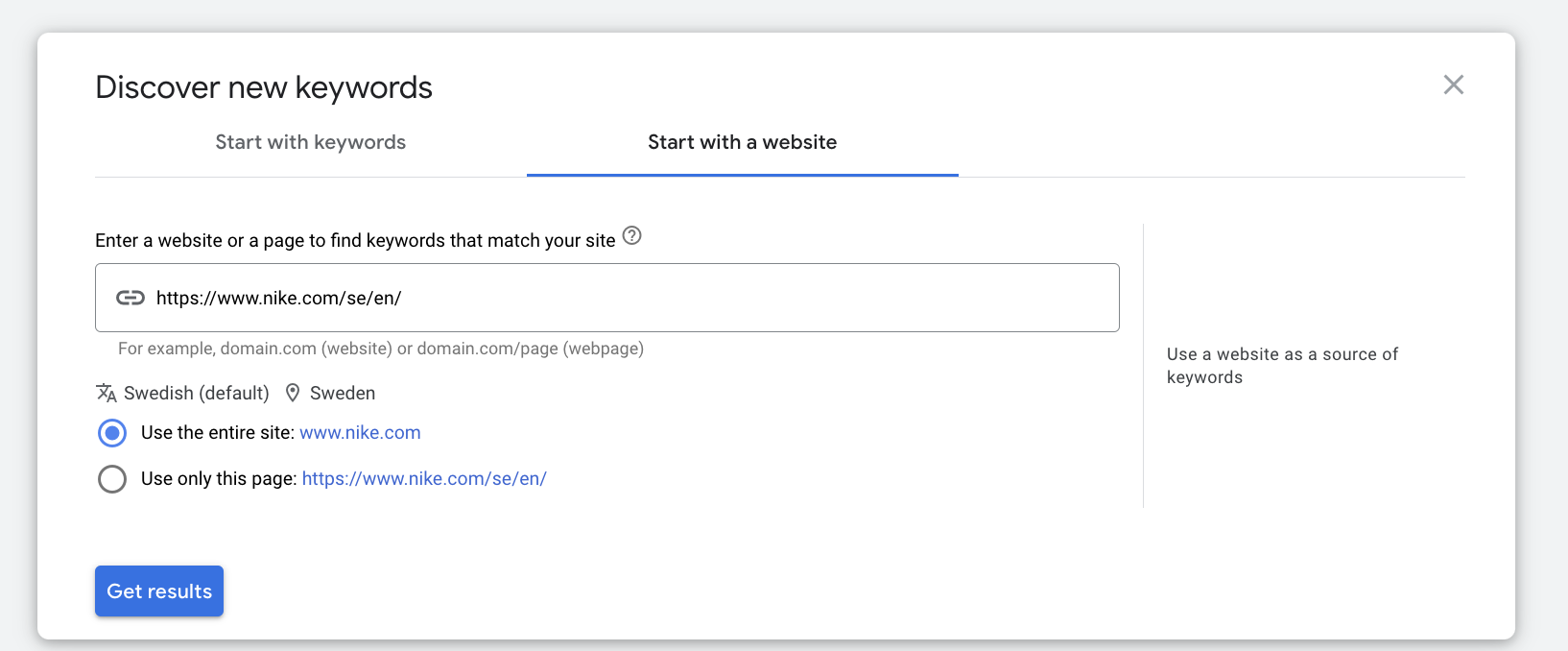
- Click “Tools and settings” → “Keyword Planner” → “Discover new keywords” → “Start with a website”
- Paste in the URL you want to check
- Make sure the right language and country are selected, then click “Get results.”
As a rule we use “Use the entire site,” but if you are running a narrow analysis and want to check individual pages you can change the settings. Download the keyword ideas by clicking “Download keyword ideas” and choose Google Sheets for easier handling.
Repeat the process for every website you want to examine and merge all the documents into one. Try to avoid analysing very large competitors with little overlap; focus instead on relevant competitors within your niche.
Make sure only relevant keywords are included in the analysis by filtering out irrelevant suggestions under “Refine keywords.”
To show up organically on Google you have to mention the keyword. So never include keywords you do not want to mention. A competitor, a competitor’s products or outdated methods, for example.
You can also filter out irrelevant suggestions by clicking “Refine keywords” on the right. There you can exclude whole categories and brands.
Copy and paste all the keywords and search volumes from every document into one of them. Strip out all data other than that.
The document should now look like this:
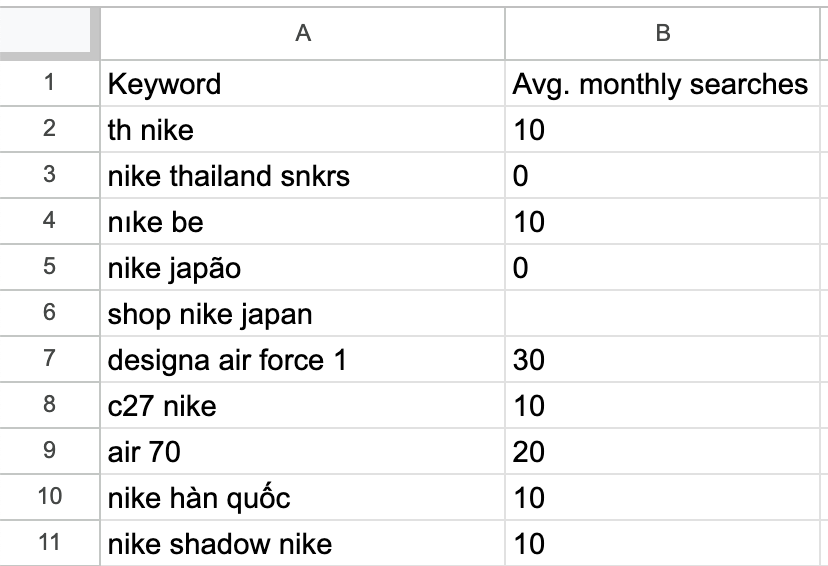
- Select columns A and B
- Click “Data” → Data clean-up → Remove duplicates
That removes every duplicate.
Start from keywords in Keyword Planner
Instead of only using URLs, you can enter specific keywords you are interested in analysing directly. You may have found these keywords in the previous step, or you simply use keywords you find interesting. Alternatively via ChatGPT, which we cover below. This is the core of the work of finding the right keywords in your keyword research.
Here is how:
- Log in to Google Ads
- Click “Tools and settings” → “Keyword Planner” → “Discover new keywords”
- Add relevant keywords, a maximum of 10 at a time.
- Choose the right language and country, then click “Get results.”
If you want to examine more than 10 keywords you have to repeat the process, merge several documents and clear out duplicates exactly as above.
Combine likely keywords systematically
Many keywords follow a logical structure and can easily be combined to create relevant variants. Combinations of your services and the towns and cities you operate in, for example.
Services
- Service 1
- Service 2
- Service 3
Cities
- City 1
- City 2
The result above is six unique combinations. Using Keyword Planner you can easily pull out search volume and relevance for each combination.
Avoid putting too much weight on whether a combination seems plausible; let search volume and competition level decide instead.
- Log in to Google Ads
- Click “Tools and settings” → “Keyword Planner” → “Get search volume and forecasts”
- Paste in all the keywords and click “Get started”
- Make sure you have the right country and language
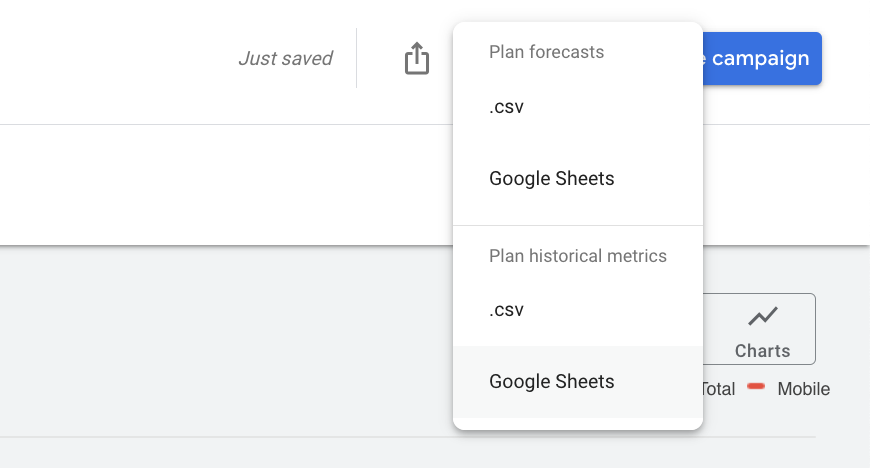
To work through these keywords we recommend clicking the icon below, at the top right:

Then choose “Google Sheets” or .csv under Plan historical metrics.
There is a limit of 10,000 keywords at a time. If you hit the limit you have to repeat the steps several times.
Merge all the keywords from all three steps above and clear out duplicates. You should now have your keywords and search volumes.
Check the competition for your keywords
SEO has its own metrics for keyword competition. As a rule they correlate with how important the keyword is.
If you have a limited number of keywords you can check the competition using the Ahrefs Keyword Difficulty Checker. If you have a lot of keywords you probably also have a paid SEO tool like the ones below that can handle it for you.
SEO tools for keyword research
There is a range of SEO tools that can help you with your keyword research.
The tools you need to get started are free, so you do not have to buy a tool purely for the keyword research. That said – if you start working more actively with SEO you will want to track your rankings, and then you should pick one of the tools below. If you use an SEO agency such as Sunbird you do not have to think about this at all.
Free tools
Answer the Public – this platform is close to our hearts. Answer the Public gives you a comprehensive overview of the most frequently asked questions around your keywords.
Ubersuggest – a tool from Neil Patel. Ubersuggest gives you a broad overview of keyword volumes and difficulty.
Keywordtool.io – a complement that generates suggestions for related and long tail keywords based on the keywords you already know about. Useful for inspiration and for making sure you have not missed anything.
On top of the above you can always use Search Console and Google Analytics. But that gives you data on where you show up today, which means you probably already know about the keyword.
Paid tools
SEMrush – a good option if you want a tool for more than SEO.
SE Ranking – specialised in SEO only.
Mangools KWFinder – a smaller tool than the ones above. Has good functionality for finding keywords.
AI for keyword research
This could be a whole post in itself. But here we set out a few of the most useful prompts for expanding your keyword research. We mainly use it to surface ideas we could not have come up with ourselves.
Keyword suggestions based on a topic
Prompt: “Generate keyword suggestions around the topic “running shoes”.”
This is often one of the first steps we take. Above all when it is a new area you do not know particularly well. You can then feed those keywords into Keyword Planner to pull out related keywords.
Identifying long tail keywords
Prompt: “Suggest long tail keywords for “yellow running shoes”.”
Generally used to generate suggestions. You will not get search volumes here, but the keywords it produces can be worth investigating further in Keyword Planner.
Running an active Google Ads campaign gives you more information about long tail keywords. In Google Analytics you do not see many of the search terms that resulted in an impression. In Google Ads, on the other hand, you see most of the search terms, which can broaden your insight into what to write about to pick up more long tail matches.
Find keywords you have missed
Finally, you can paste in all your keywords and ask ChatGPT whether there are any keywords you have missed.
Prompt: “Are we missing any keywords about running shoes in the list below?”
[Enter the list in GPT]
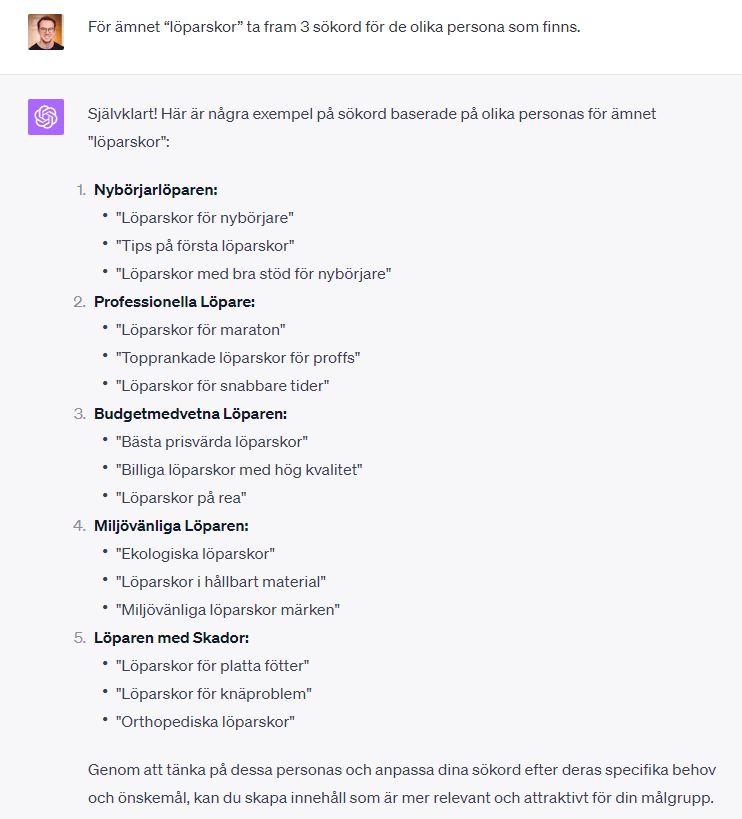
Prompt: “For the topic “[topic]”, produce 3 keywords for each of the personas involved.”
The result might look like this:
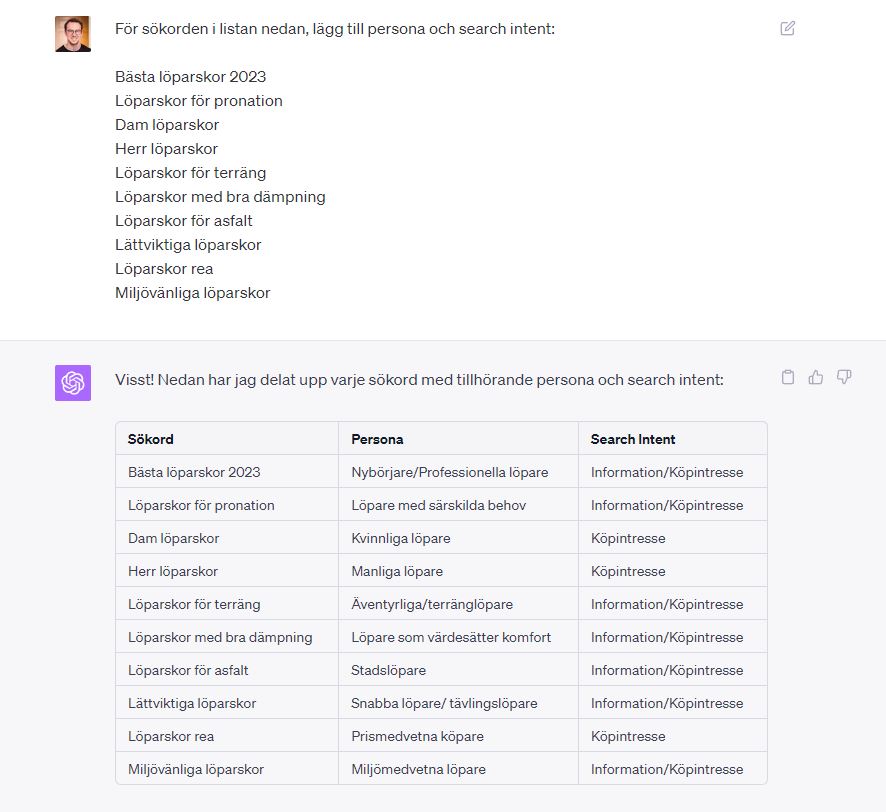
Bonus: this is not part of the keyword research as such. But something that has become popular is to ask ChatGPT to produce personas and search intents once the whole keyword research process is finished.
Prompt: “For the keywords in the list below, add persona and search intent:”
[Lista]
Result:
Long tail often shows no search volume
Even though Google optimisation still revolves around keywords, you should not fixate on the keywords themselves. Focus on topics rather than keywords.
A long tail keyword might be “yellow running shoes for men on tarmac”, for example. Keywords like that normally have no search volume because they are so specific. But if you offer exactly that and the user lands on your website, the close rate is generally higher than for a broader keyword.
Taken together, long tail means more potential customers with a high close rate at lower competition than exact matches.
If we take shoes as an example and we were writing a product or category page, we would want to include:
- All the colours
- Spell out all the sizes
- State all the suitable surfaces and terrains
- Say who it is aimed at
Use the keyword research to find interesting topics – but do not settle for writing a longer version of what already exists. AI models are experts at summarising consensus, so broader is not enough. You have to add something unique (more on Information Gain further down).
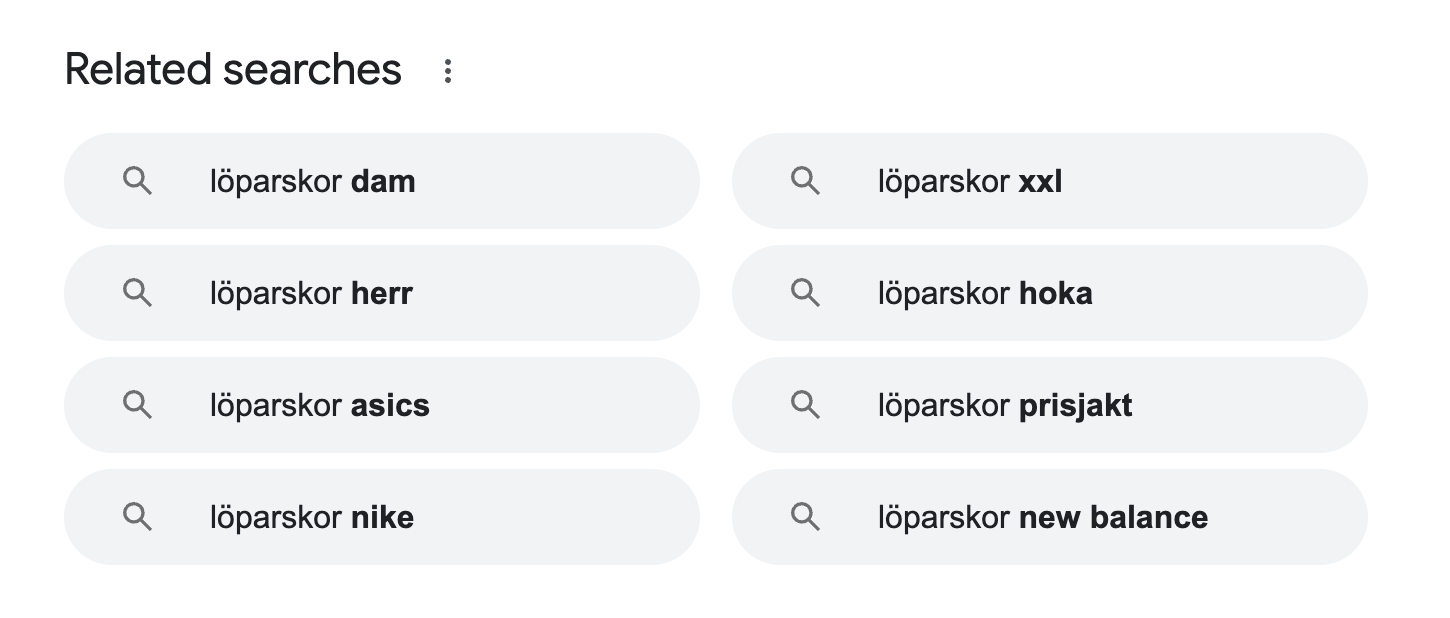
Related searches
A trick that has been used for a long time is to run a Google search and study the results at the very bottom.
That can give you inspiration for both new keywords and long tail.
Find keywords by analysing competitors
One step you should not forget is to analyse your competitors.
Beyond entering their URLs in Keyword Planner, you can do a manual check.
The fastest way to form a judgement is to look at their sitemap. You will normally find it at .co.uk/sitemap.xml.
You can of course also look at their navigation and the words they use on their main pages. Those keywords are usually important to them.
The purpose of this is primarily to understand which keywords your competitors prioritise. If they have an active SEO plan, an experienced eye can read out almost the entire strategy.
Build content clusters, not scattered keywords
A clear pattern among the players who win is that they build topical authority through interlinked content clusters – several pages covering different aspects of the same overarching topic – instead of chasing individual, scattered keywords. That makes the whole site look like an expert in the field, not just one specific page.
Concretely: if you sell building materials, ranking for “decking timber” is not enough. You also want to cover “how to build a deck”, “decking balustrades”, “treating decking boards” and so on – and link them together into a coherent resource.
This is more resilient to algorithm updates and AI summaries than optimising individual landing pages in isolation. So when you run the competitor analysis, do not just look at which individual keywords the competitors rank for – look at how their pages link together into topic clusters.
Information Gain – how to create content the AI cannot copy
Information Gain is the added value your content brings beyond what is already indexed. Because AI models are experts at summarising consensus, it is no longer enough to write a longer or “better” version of a competitor’s article – you simply become raw material for the AI instead of a destination the user wants to visit.
For your content to have value in its own right – and therefore be cited in AI answers and rewarded by the search engine – you should build in four types of information gain:
- Proprietary data: your own statistics from your customers, your campaigns or your processes. Nobody else can copy that.
- Contrarian perspectives: be willing to challenge what the industry takes for granted, if you have grounds for it.
- First-hand narrative: concrete experience from your own work – not aggregated opinions from other people’s blogs.
- Original visual data: your own charts, comparison tables and illustrations that the AI cannot hallucinate.
Apply this in your keyword research by asking, for every prioritised keyword: “What can we say about this topic that nobody else can say?” If the answer is “nothing” – then the keyword may not be worth investing in right now.
If we say A in the ad, we say A on the landing page – and if you say you are an expert in a field, your keyword research should lead to content that actually proves it. That is how you future-proof your SEO against AI summaries.
From keywords to entities – think concepts, not just strings
Modern keyword research is not only about strings of characters but about entities – the objects and concepts that exist in Google’s knowledge graph. An entity can be a person, a place, a product category or a concept such as “deck building”.
The difference in practice:
| Traditional keyword research | Entity-based keyword research |
|---|---|
| "Which exact keywords do people search for?" | "Which concepts and relationships do we cover?" |
| Optimises for matching words | Optimises for covering the topic |
| Vulnerable to synonyms and rephrasing | Robust against AI paraphrasing |
| Ranking per keyword | Topical authority |
For your keyword research: once you have listed your prioritised keywords, go a step further and ask: “Which entities, questions and sub-topics belong to this subject area?” That is where you find the gaps the competitors have missed – and where you build the site the AI sees as the authority on the topic.
Strategy – how to choose the right keywords in your optimisation
Which keywords you should prioritise will differ between SEO and Google Ads.
Not all search volume is equal
When people do keyword research for Google, it is common to automatically prioritise the keywords with high search volume.
Not all services and products carry the same value. So we should avoid comparing search volumes directly and instead try to add nuance to the picture to make it more commercially oriented.
A keyword with high search volume can just as easily come with high competition, low buying intent and low order value.
Once you have pulled out all the keywords in your keyword research, you can use the equation below:
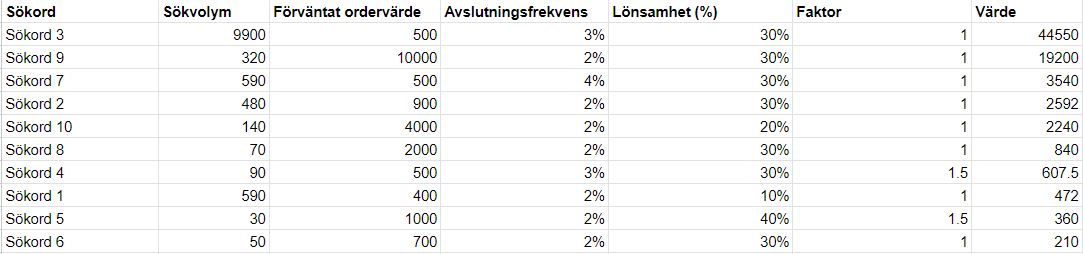
- Search volume – from Google Keyword Planner
- Average order value – where there are clear differences
- Close rate – where it can be separated out
- Profitability – as a percentage
- Factor – where one exists, such as less administration. For example if you work B2C towards homeowners and it is an area with large detached houses
By multiplying all of these factors together we get a more nuanced picture of what the keywords mean for sales. It does not matter if the figures are not exact when that is hard to do – approximate is better than nothing.
Cost per click – a clue
An alternative to the above is to look at the estimated CPC bid (cost per click) in Google Ads instead. Because it is an auction, advertisers will want to bid more on the keywords that matter to them. A higher cost per click should therefore correlate with the keyword being important.
- Log in to Google Ads
- Click “Tools and settings” → “Keyword Planner” → “Get search volume and forecasts”
- Paste in all the keywords
As well as helping you prioritise the keywords, this also gives you a sense of the potential in your SEO campaign. Advertisers will not bid more than it is worth to them. If you work out the total cost, you know the revenue is bigger.
Measure “share of voice” – not just position
Because AI Overviews and zero-click searches take an ever larger share of the SERP, measuring position alone is not enough. You also want to know how often your brand is mentioned or cited in AI-generated answers – what is often called “share of voice” in AI search.
In practice: search regularly on your prioritised keywords and document which sources AI Overviews cite. Do you come up? Do your competitors? That says more about your future visibility than your position as a blue link.
A common pattern is companies that have lost traffic volume and still grown their revenue – because the clicks that remain are more qualified. For your keyword research that means: prioritise keywords with clear buying intent and put less weight on broad informational searches where AI takes over the answer. If you need help thinking this through, that is where we come in as an SEO agency.
Choose the right keywords for the channel
When you do keyword research, the same keywords should not be used for both SEO and Google Ads.
Choosing the right keywords for Google Ads
Google Ads used to be very much about having one keyword per ad – so-called SKAGs, Single Keyword Ad Groups. Now it is more important to build STAGs – Single Topic Ad Groups.
So you do not have to know every keyword, search volume, competition level and so on. Doing keyword research gives you a good sense of the potential and which topics you can build out.
Another big difference in the choice of keywords, or topics, between SEO and Google Ads is that you pay for every click. So for every keyword you add, you are indirectly saying no to something else.
Choosing the right keywords for SEO
In SEO there is no direct trade-off in the sense that a yes to one keyword indirectly takes part of a budget away from another keyword.
That said, you can obviously only start with one keyword at a time, so it becomes a question of prioritisation and pace instead.
The recommendation is therefore to include more keywords than in Google Ads, but to set a clear order of priority.
It is better to win on a handful of keywords with decent search volume and high buying intent than to lose on many.
New websites that struggle to rank should avoid overly competitive keywords. Creating the important pages is obviously a good start, but lower your expectations. Instead you can work around the competition on those particular keywords and start with the slightly easier ones. Once you are winning on those, you can go back to the page with higher competition.
Strip out variants of the same keyword
Once you have found all the keywords and are about to start tracking them, we recommend removing the variants. The main reason is to keep the number of keywords down, which is easier to work with, and to avoid over-reporting. Rank tracking tools will give you data on both keywords even though they are effectively the same.
Stop words: a stop word can be described simply as a word that does not change the meaning. “in”, “for” and “to”, for example. If you have the keywords “service in city” and “service city” we recommend keeping only one of them. The rankings are not always exactly the same for these two variants, but they are close enough that it simplifies the analysis.
Reversed order: “service city” and “city service” do not both need tracking.
Plural: if the keywords exist in both plural and singular we recommend keeping whichever of the two fits better, but not both. If you want to be thorough you can spot-check whether your results differ much between the two. If they do, it can be worth keeping both – possibly only for your most important keywords, while avoiding it as a general rule.
Keep an eye on trends
New keywords do not get accurate search volume straight away. So you cannot find the keywords and the search volumes they will end up with. If it is not obvious, write as well as you can and review the keywords once they have become established.
When new services or products come out it usually pays to be first. That can make Google start to see you as a source with up-to-date information; read more about E-E-A-T for SEO.
Summary
Keyword research is the foundation of your Google optimisation. So put in the time it takes to do it properly.
Prioritise your keywords correctly and do not use every keyword you find. Start with the most important ones and expand as you see clear ROI. And remember: in the AI era it is not search volume that wins – it is the ability to add something unique and capture the clicks that actually lead to business.
If you want help with your keyword research, you are very welcome to get in touch. We are an SEO agency working with clients across the UK and in 10 countries. Keyword research is included in all our SEO packages, and we are happy to help you build it out into a concrete growth strategy.