


SEO KPIs: how to measure the results of your search engine optimisation
The right SEO KPI depends on the stage of the project. Average position, estimated traffic, organic traffic and leads measure different things at different times.

An SEO KPI (key performance indicator) is a measure that shows whether your search engine optimisation is moving in the right direction. The right KPI depends on where you are in the project: average position and estimated traffic at the start, organic traffic and leads once the work has matured. Since AI Overviews arrived in the search results, counting clicks is no longer enough. You also need to measure how often your brand appears and is cited.
Average position, estimated traffic, organic traffic and leads measure different things at different times, and mixing them up gives a distorted picture of your SEO.
Why KPIs matter for SEO
KPIs matter for SEO because search engine optimisation takes time. Without the right measures, you won’t know whether the work is heading in the right direction until it is too late. Anyone reading this will already know that measuring results matters, but here are three good reasons to measure your SEO:
- Because SEO takes time, you need to know which KPIs to look at in order to judge whether the work is on track.
- Showing decision-makers the right measures for the stage the work has reached is essential to justify carrying on.
- KPIs help SEO specialists judge which piece of work will have the greatest effect.
Below we go through the SEO KPIs we use and the order in which each becomes the primary measure: average position → estimated traffic → organic traffic → leads. In the commercial phase we add Google Ads to that ladder, because paid and organic search compete for the same customers on the same results page.
KPI: Average position
Your average position is the average ranking across the keywords you track. For it to be reliable, you need to measure the same keywords throughout the period you are comparing. You will find the keywords you want to work on in your keyword research.
Important: measure average position on a fixed, controlled list of tracked keywords, never as an average across the whole domain. It is one of the most damaging mistakes you can make. When successful SEO work starts ranking for hundreds of new keywords in positions 30–70, the domain-wide average drops for purely mathematical reasons. Visibility then appears to be getting worse, even though both traffic and the number of ranking keywords are rising. A fixed list of 50–200 of your most important keywords solves the problem.
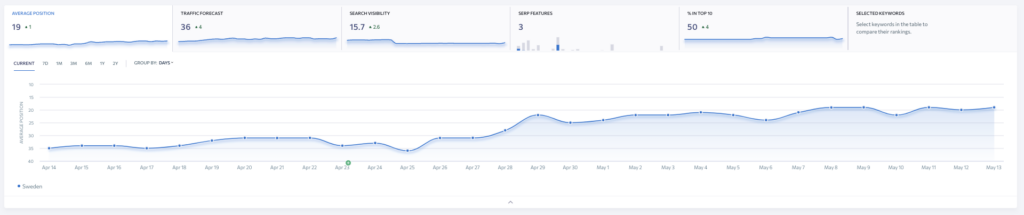
The chart shows one of our clients in Sweden, whose average position improved from 35 to 19. Below we show other KPIs over the same period.
The first thing that happens when you start on SEO is that average position improves. The keywords don’t need to reach the first page to do so, which is why it doesn’t necessarily lift your estimated or actual traffic by much.
Your average position is therefore a leading indicator of whether the work is producing results. If it is moving up, something is being done right.
Average position works best in an early phase, when most keywords rank poorly. After a while it stops being relevant: a keyword can easily move from position 100+ to 20, which shifts your average position far more than a keyword moving from five to one. The latter, however, does far more for your estimated traffic.
KPI: Estimated traffic
Estimated traffic is a mathematical model that estimates how much traffic you get from the keywords you track. The model assumes that the top positions take a large share of the clicks and that the share falls quickly further down the page. Exactly how large a share each position gets is no longer a fixed figure. Click-through rates have shifted sharply in recent years as the results page has changed. Ahrefs found that the top organic result loses 58 per cent of its clicks when an AI Overview appears above it. Treat estimated traffic as a direction of travel, not a precise forecast.
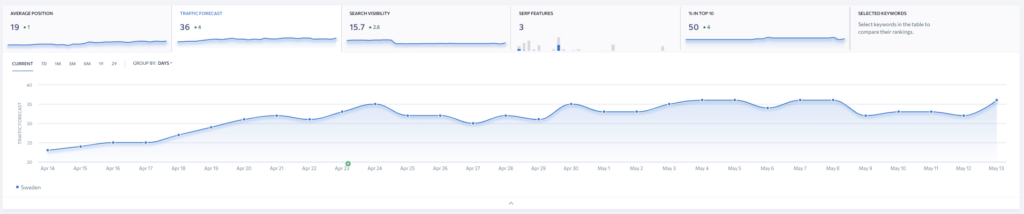
In the chart above, estimated traffic (labelled traffic forecast in the tool) has risen from 23 to 36. It covers the same dates and the same website as the average position chart. Over a month, that is not much more estimated traffic and it hardly affects the business. Looking at estimated traffic alone would therefore be misleading, because the leading indicator, the improving average position, is a much stronger signal.
The reverse also happens: average position falls while estimated traffic rises.
As a rule, you only get meaningful estimated traffic on Google’s first page. In new projects it takes time to rank there, so this is not the KPI to start with.
Once the project matures, however, estimated traffic is a better measure than average position, because it takes each keyword’s search volume into account.
Estimated traffic climbs steeply when higher-volume keywords approach the top half of the first page.
Bear in mind that estimated traffic ignores seasonality, so it does not always reflect reality. For SEO, though, it gives a stable measure that is not affected by external factors.
One more thing has become important: informational content often loses clicks when Google answers the question directly in an AI Overview, but that rarely means the content has stopped working. In a study by Seer Interactive, brands cited as a source in an AI Overview got 35 per cent more organic clicks than when they were not cited. Estimated traffic does not capture that value, so for your buying guides and informational pages you should also track how often you appear and are cited (more on that further down).
KPI: Organic traffic
Organic traffic is the actual traffic to your website from the organic parts of Google. Bear in mind that not all of it is tracked: if your set-up is done properly, visitors have to agree to tracking first.
This is where many people fall into a trap: GA4 does not show the whole truth about your organic traffic. The GA4 tracking script loads in the visitor’s browser and depends on consent, so part of your traffic disappears from the data when visitors decline tracking. Add ad blockers and scripts that load too late, and the gap can be considerably larger. Google Search Console, by contrast, records clicks directly at Google and is not affected by cookie banners or ad blockers. Use Search Console as the source of truth for how many people searched and clicked, and GA4 to understand what visitors did after they landed.
A good rule of thumb: if clicks in Search Console are stable but organic sessions in GA4 drop sharply, it is almost always a tracking fault, not a Google penalty. Check the cookie banner and make sure tracking loads as it should before you draw any conclusions.
If you are visible for relevant keywords and have a good website, this traffic is very likely to bring you more new customers.
SEO work is best judged by comparing organic traffic with the previous year. That way you filter out seasonal effects, for example.
Bear in mind that without any filtering, your report will include all organic traffic, whether or not it is down to SEO. One tip is to build a report in Analytics that covers only your SEO landing pages.
Split traffic into brand and non-brand
If you measure organic traffic without separating brand searches from generic searches, you get a distorted picture. Crediting SEO with a rise in brand searches means taking credit for something PR, advertising and general awareness produced. It is the trend in non-brand traffic that truly shows whether your SEO is reaching new customers.
| Type of search | What it is | What mainly drives an increase |
|---|---|---|
| Brand | Searches that include your company or product name | PR, offline advertising, general awareness |
| Non-brand (generic) | Searches for a product, service or problem where the customer has not yet chosen a supplier | Your SEO work and new rankings |
Set up two filters in your reporting: one that captures every query containing your name (brand) and one that excludes them (non-brand). You can then show management exactly how much new business SEO has brought in, without mixing in traffic you would have had anyway.
KPI: Leads from SEO
In the end, it all comes down to winning more customers. If the number of leads from SEO is rising, the project is working.
Once your actual traffic has grown over a longer period, you should see more leads, especially if you have a good website and are visible for the right keywords.
When the SEO work is well advanced, you can start measuring leads from SEO in the same way as organic traffic, ideally against the previous year.
Bear in mind that the leads you measure in Analytics need to stay the same over time. Be careful about changing them, as you lose the ability to compare.
An important point in the AI era: not all traffic is worth the same. Traffic from AI chatbots and LLM search is still small in volume, but those visitors can convert far better. Ahrefs found that on its own website, visitors from AI search converted at 23 times the rate of traditional organic search visitors. They have already done their research in the conversation with the AI and arrive on your site to do something specific. A handful of those visits can be worth more than hundreds of ordinary clicks. So don’t write off a channel just because the volume is low. Look at what the visits lead to.
KPI: Visibility in AI answers
Visibility in AI answers is a KPI that measures how often your brand appears and is cited in AI Overviews and chatbots, rather than how many people click through. For informational content, this is the new measure of success, because Google often answers the question directly without sending the visitor anywhere.
The key thing to understand is that you can be cited without ranking highly in the usual way. Ahrefs found that only 38 per cent of pages cited in AI Overviews also rank in the top 10 of the traditional results for the same query. Watching average position alone therefore misses a large part of your visibility.
Two KPIs you should start tracking for informational pages:
- Citation rate in AI answers: how often your page is given as a source or link inside the AI Overview for your priority keywords.
- Growth in brand searches and direct traffic: when you appear in AI answers, many people get their answer straight away and then search for your name or go directly to your website. A rise in brand searches and direct traffic is a sign that your exposure in AI answers is working.
In practice, this means a buying guide can lose half its clicks and still be worth more than before, if it is cited as a source and the people who do click through have stronger buying intent. So measure the right thing for each page: clicks and conversions on your commercial landing pages, citation rate and reach on your informational pages.
The commercial phase: measure SEO and Google Ads together
In the commercial phase, when you are steering towards leads, sales and revenue, you can no longer look at SEO in isolation. Organic search and Google Ads compete for the same customers on the same results page, and each affects the other.
A concrete example: say your landing page has a 2 per cent conversion rate (two in 100 visitors become a lead) while your competitors are at 3 per cent. They can then bid more per click in Google Ads and still be more profitable than you. The same page that improves your organic conversion rate also makes your advertising more profitable. Measuring the two separately hides that connection.
In the commercial phase, you should therefore look at:
- Leads and revenue from non-brand organic search.
- Leads and revenue from Google Ads, broken down by keyword.
- The total cost per lead across both channels.
- How an improved landing page affects both organic conversion and the profitability of your advertising.
The point is that investing in your website is usually a one-off cost, whereas a higher ad budget carries on month after month. When SEO and Ads are measured together, you can see where the money does the most good.
Use SEO KPIs to decide what to do next
The four SEO KPIs on the ladder are not just for reporting. They also tell you what to do next. Anyone used to analysing these four KPIs tends to develop a good feel for a project and its momentum. It also gives you a clear view of which parts of your SEO to prioritise.
- If all your keywords rank poorly, look at broad issues such as technical SEO or external links.
- If most keywords rank well but a few rank much worse, the problem is local, for example on-page SEO.
Conversely, if you are losing rankings, it is worth checking whether average position as a whole is falling or whether individual keywords are losing top positions.
And if organic click volume falls while your brand searches and direct conversions rise, that usually does not mean your SEO has failed. More often, you are showing up strongly in AI Overviews: readers get their answer on the results page and then come straight to you to buy.
If you want SEO measured by the business it brings in, our SEO agency page explains how we work, and a free search audit shows where your site stands today.
Frequently asked questions about SEO KPIs
What does KPI stand for?
KPI stands for key performance indicator. It is a measure that shows how well you are performing against a defined goal. For SEO, that means measures such as average position, organic traffic and leads.
What is a good KPI for SEO?
A good KPI for SEO is one that reflects where you are in the project and what your business goal is. Early on, average position on a fixed keyword list is a good KPI; later, non-brand organic traffic and leads. There is no universal template: an online retailer steers towards sales, a B2B company towards qualified leads.
How do you track SEO performance?
SEO performance is best tracked with Google Search Console for how many people searched and clicked, and Google Analytics (GA4) for what visitors did after they landed. Search Console is the technical source of truth for clicks, because it is not affected by cookie banners or ad blockers.
How often should you review your SEO KPIs?
Review your SEO KPIs monthly to see the momentum, but draw your conclusions by comparing with the same period the previous year. Month-on-month comparisons are often misleading because of seasonal swings in search behaviour.
If you would like help with your SEO KPIs and setting up the right measurement, do get in touch.